How-To
How to Clean Car Windows Without Streaks (Real Fix)
Key Takeaways
- To clean car windows without streaks, use two clean microfiber towels: one to apply an ammonia-free glass cleaner and wipe, one dry towel to buff.
- Never clean glass in direct sun, because the cleaner dries before you can wipe it and leaves streaks.
- Most streaks come from a dirty towel, too much product, or leftover residue, not the cleaner itself.
- Wipe the inside of the glass with horizontal strokes and the outside vertically, so you can instantly tell which side a streak is on.
- Ammonia-based cleaners can damage window tint and off-gas inside the cabin, so ammonia-free formulas are the safer choice.
To clean car windows without streaks, apply an ammonia-free glass cleaner with one clean microfiber towel and immediately buff dry with a second clean towel, always out of direct sunlight. That two-towel habit fixes the vast majority of streaks people fight with.\n\nHere is the part almost nobody tells you: the streaks are rarely the glass cleaner's fault. They come from a towel that is already dirty, too much product pooling on the glass, or a haze of old residue you never fully removed. Fix those three things and streak-free windows become routine, not luck.\n\nOur technicians detail cars all over San Francisco, where fog, marine layer, and salt air make glass clarity a real safety issue. Below is the exact method we use so your windshield stays clear when the visibility drops.
Why do my car windows streak after I clean them?
Streaks are almost always a process problem, not a product problem. Once you know the four usual causes, you can stop guessing and fix the real one.
The biggest culprit is a dirty or fabric-softener-loaded towel that smears residue instead of lifting it. The second is too much cleaner, which pools and dries unevenly. The third is cleaning in direct sun, so the product evaporates before you can buff it. The fourth is a film of old cleaner, wax overspray, or off-gassed plastic haze that a single pass never removes.
- Dirty towel: drags old grime and lint back across the glass
- Too much product: excess cleaner pools and dries into streaks
- Direct sun or hot glass: cleaner flashes off before you buff
- Leftover film: old residue or interior haze needs a second pass
Pro tip: Wash microfiber towels on their own with zero fabric softener and no dryer sheets. Softener leaves a waxy coating that guarantees streaks on glass, no matter how good your cleaner is.
What is the two-towel method for streak-free glass?
The two-towel method is the single fastest fix for streaks, and it is what separates a pro finish from a smeary one. You use one towel to clean and a second, bone-dry towel to buff.
Spray the glass cleaner onto the first microfiber towel, not straight onto the glass, so you control the amount and avoid overspray on your dash or trim. Wipe the whole panel to lift the dirt. Then immediately follow with the dry towel to buff the surface clear before anything can dry down.
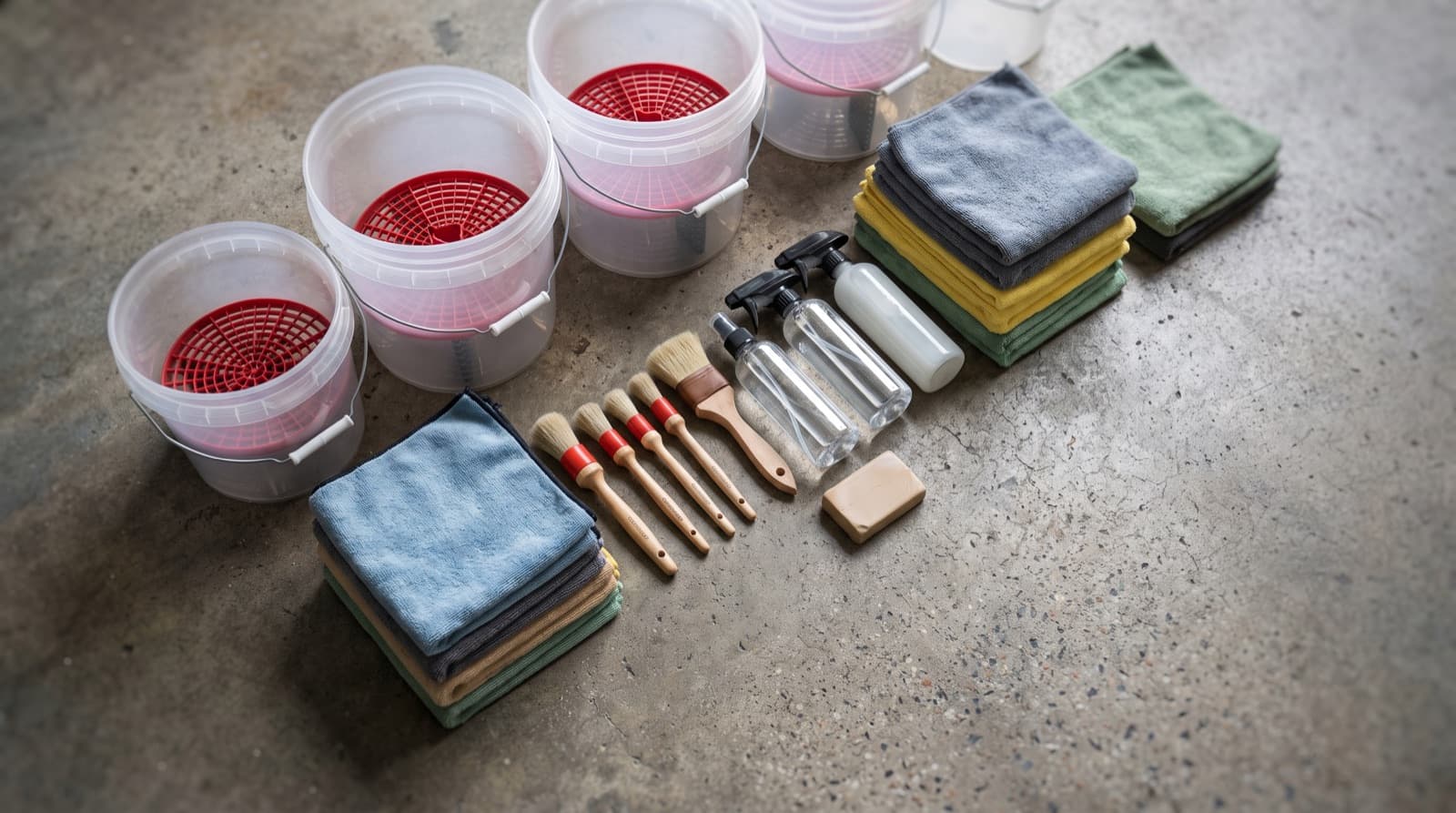
Fold each towel into quarters so you have eight clean faces to rotate through. The moment a face looks damp or dirty, flip to a fresh one.
- Towel 1 (slightly damp with cleaner): lift and remove the grime
- Towel 2 (clean and dry): buff the glass to a clear finish
- Use plush, edgeless microfiber in the 300-400 GSM range for glass
- Rotate to a fresh fold the second a face gets dirty or wet
Should I use an ammonia-free glass cleaner?
Yes. For a car, choose an ammonia-free glass cleaner. Ammonia cleans well on house windows, but inside a vehicle it creates two problems.
First, ammonia can dry out and eventually damage window tint film, causing it to bubble or turn purple. If your car has any aftermarket tint, ammonia is a slow way to ruin it. Second, ammonia off-gasses in a sealed cabin, leaving that sharp smell and irritating your eyes on the drive home.
Good ammonia-free options include Invisible Glass, Stoner Invisible Glass, Chemical Guys Streak Free, and Meguiar's Perfect Clear. In a pinch, a 50/50 mix of distilled water and isopropyl alcohol cuts interior film well. Distilled water matters in hard-water areas because tap minerals leave their own spots.
| Cleaner type | Tint-safe? | Best for | Streak risk |
|---|---|---|---|
| Ammonia-free auto glass cleaner | Yes | All car glass, tinted windows | Low |
| Ammonia-based (household) | No | Untinted house windows only | Medium |
| Distilled water + isopropyl alcohol | Yes | Interior haze and film | Low |
| Tap water alone | Yes | Light dust only | High (mineral spots) |
How do I clean the inside of the windshield without haze?
The inside of the windshield is where most people give up. That greasy film is real. It comes from off-gassing plastics and vinyl, your defroster baking those oils onto the glass, plus smoke and skin oils over time.
Reach the base of the windshield by working from the passenger seat, not the driver seat, so you can actually get your arm flat against the glass. A stubby glass tool wrapped in a microfiber towel gets into the deep corner where the dash meets the glass.
Do two light passes instead of one heavy one. The first pass cuts the oily film; the second buffs it clear. One soaked pass just moves the grease around and dries into haze.
Pro tip: For a heavy interior film, do a first pass with isopropyl alcohol to strip the oil, then a second pass with your regular ammonia-free cleaner to finish. The alcohol breaks the grease so the final buff actually goes clear.
The vertical and horizontal trick to find which side is streaking
Here is a pro trick that saves you from re-cleaning the wrong side of the glass. Wipe the inside of every window with horizontal strokes and the outside with vertical strokes.
Now when you spot a streak, its direction tells you exactly where it lives. A horizontal streak is on the inside; a vertical streak is on the outside. You stop guessing and fix the right surface in seconds.
It sounds small, but on a windshield you cannot reach easily, knowing which side to re-buff is the difference between one quick fix and ten frustrating minutes.
- Inside glass: wipe with horizontal (side-to-side) strokes
- Outside glass: wipe with vertical (up-and-down) strokes
- Streak going sideways = it is on the inside
- Streak going up-and-down = it is on the outside
Why streak-free glass matters more in foggy San Francisco
In most cities, streaky glass is an annoyance. In San Francisco, it is a visibility hazard. Our marine layer and Sunset-district fog roll in fast, and low sun angles through the fog turn every streak and haze patch into a blinding glare.
Salt air off the Pacific leaves a fine film on your exterior glass, and water spots from street washing or sprinklers bake on quickly. That film scatters light exactly when you need to see a pedestrian stepping off a curb in the mist.
Because most SF drivers park on the street with no garage, glass collects fog residue, tree sap, and grime around the clock. A quick two-towel wipe on your windshield once a week keeps night and fog driving genuinely safer.
Pro tip: Keep two clean microfiber towels and a small bottle of ammonia-free cleaner in your door pocket. A 60-second wipe before a foggy night drive across the city cuts glare more than any wiper blade upgrade.
When should you leave it to a pro?
Cleaning your own glass is completely doable, and you should do it regularly. The two-towel method works in your own driveway with a $10 bottle of cleaner.
Go to a pro when the problem is not on the surface. Deep water spots that have etched the glass, wiper haze, or an interior film so baked on that two passes will not touch it usually need a clay bar, a glass polish, or a proper interior deep clean. Those steps take the right products and some experience to do without damaging tint or trim.
As a full-service mobile detail, we clean and clarify every window as part of an interior or full detail, so you are not left doing the hardest-to-reach glass yourself.
Frequently Asked Questions
What household product cleans car windows without streaks?
A 50/50 mix of distilled water and isopropyl alcohol works well and is tint-safe. Use distilled water rather than tap, since tap minerals leave their own spots, and always buff dry with a clean microfiber towel. Avoid household ammonia cleaners like some blue formulas, because ammonia can damage window tint over time.
Can I use paper towels to clean car glass?
It is better to avoid them. Paper towels leave lint, break down when wet, and can lightly scratch glass over many cleanings. A plush, edgeless microfiber towel lifts residue cleanly and buffs to a clear finish with far less streaking. Keep a dedicated set of microfiber towels just for glass.
Why does my windshield look streaky only when the sun hits it?
Low-angle sun reveals a thin film of residue or interior off-gassing haze that you cannot see in flat light. It usually means the glass needs a second, lighter pass to buff that film clear rather than a heavier single pass. This is especially common in San Francisco, where fog and low sun combine to expose every streak.
How often should I clean my car windows?
For most drivers, a quick two-towel wipe of the windshield and front windows once a week keeps visibility sharp. If you park on the street in San Francisco with fog, salt air, and tree sap, you may want to wipe the windshield more often. A full interior glass cleaning fits naturally into a monthly maintenance detail.
Does Golden Bay Detailing clean windows as part of a detail?
Yes. Every window, inside and out, is cleaned and clarified as part of our interior and full detail packages, including the hard-to-reach base of the windshield. We are fully mobile across San Francisco, the Peninsula, and Marin, and we bring our own water and power to your driveway or office. Request a free quote and we will come to you.
Keep reading from Golden Bay
Want spotless, streak-free glass without the work?
We come to your San Francisco driveway or office with our own water and power, and clean every window inside and out. Get a free quote today and drive with a clear view.