Problem Solvers
How to Get Mold Out of Your Car Safely and for Good
Key Takeaways
- To get mold out of a car, vacuum loose spores, kill the mold with an enzyme or anti-microbial cleaner, agitate the surface, then extract the moisture and dry the car fully. Wiping alone leaves living spores behind.
- Mold always grows from a moisture source: a leak, wet floor mats, a cracked door seal, or damp air trapped inside. You must fix and dry that source or the mold comes right back.
- Wear an N95 mask and open every door for ventilation before you disturb car mold, because spores go airborne and can trigger allergies and asthma.
- Steam and enzyme cleaners kill mold at the root. Bleach and vinegar may lighten a stain but often fail to reach spores buried deep in foam and padding.
- If mold has soaked into seat foam or carpet padding, that material may need to be replaced. Surface cleaning cannot fully save saturated foam.
To get mold out of your car, kill the spores with an enzyme or anti-microbial cleaner, agitate the surface, then extract the moisture and dry the car completely. Wiping the fuzz away is not enough. If living spores stay behind in the foam and fabric, the mold grows right back within days.
Mold in a car is a health problem first and a cleaning job second. Those green, white, or black patches release spores you breathe every time you sit down, and in a sealed cabin they concentrate fast. So before we talk products, we talk safety.
Our technicians have detailed over 500 cars around San Francisco, and mold is one of the most common interior calls we get. Our fog, marine layer, and no-garage apartment living make cars damp for weeks at a time. Here is exactly how to clear it out, and how to keep it from coming back.
Why does mold grow in cars? (and why SF makes it worse)
Mold needs three things: a spore, food, and moisture. Spores are already everywhere in the air. Food is easy too, since dust, skin cells, crumbs, and fabric are all a feast. That means moisture is the one factor you actually control, and moisture is the whole story.
In San Francisco, the deck is stacked against you. Fog and the marine layer keep humidity high for days. Salt air holds moisture. And most of us park on the street with no garage, so a car never fully dries out between soggy mornings.
But ambient damp alone rarely does it. Almost every bad case our technicians open up has a real water source feeding it.
- A leak: a cracked windshield seal, a bad door or sunroof gasket, or a clogged sunroof drain letting rain in.
- Wet floor mats or carpet from muddy shoes, a spilled drink, or a wet dog.
- A window left cracked overnight during a fog roll-in or light rain.
- Damp gym bags, towels, or umbrellas left on the seat or floor for days.
Pro tip: If mold keeps coming back on the same spot of carpet, stop cleaning and start hunting. Nine times out of ten there is water pooling under the mat from a clogged drain or a worn seal, and no cleaner on earth beats a steady leak.
Stay safe first: mask, gloves, and ventilation
Disturbing mold sends a cloud of spores into the air, right into the small cabin you are leaning into. People with asthma, allergies, or a weak immune system can react badly, and even healthy people should not breathe a lungful. Gear up before you touch anything.
This is the step most DIY guides skip, and it is the one that actually matters for your health.
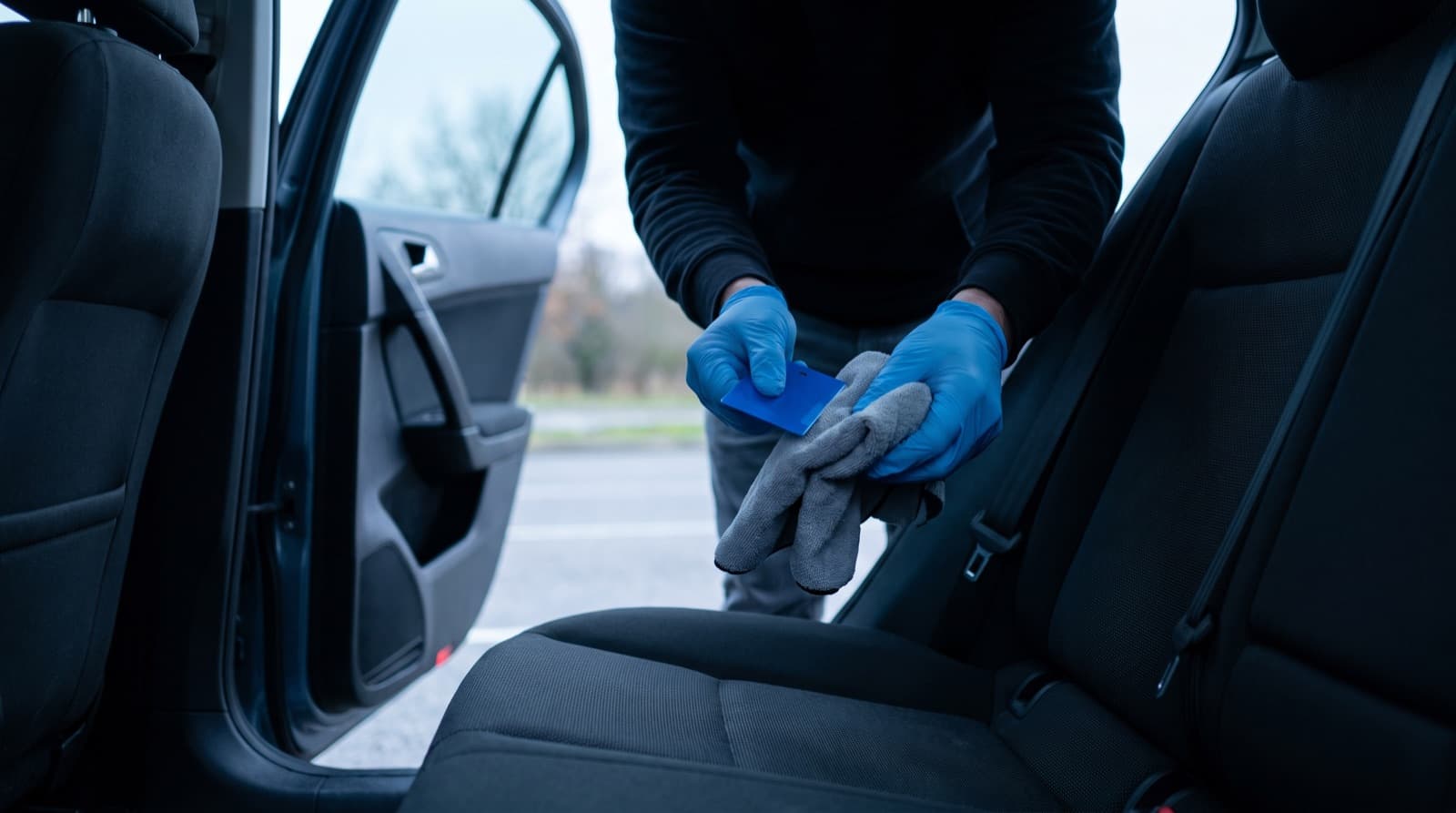
- Wear an N95 or better respirator, not a cloth or surgical mask. Those do not stop spores.
- Put on nitrile gloves and, for a heavy job, eye protection.
- Open all four doors and the trunk, and work outside or in an open garage, never a closed one.
- Take heavily molded, removable items like floor mats out of the car to clean them separately.
- If mold covers more than a couple of square feet, or anyone who rides in the car has asthma, treat it as a pro job rather than a weekend project.
How to get mold out of your car, step by step
Once you are geared up and the doors are open, work in this order. The sequence matters: you remove, then kill, then dry. Skip the kill step and you just spread it around.
- 1. Vacuum first. Use a vacuum with a HEPA filter to lift loose spores off seats, carpet, and mats. Empty it outside, not in the house.
- 2. Apply your killer. Spray an enzyme or anti-microbial cleaner made for interiors onto every affected area until damp. Let it dwell the full time on the label, usually 5 to 15 minutes, so it reaches the roots.
- 3. Agitate. Work the surface with a soft brush to break the mold loose from fabric weave and seams. Do not grind it into the foam.
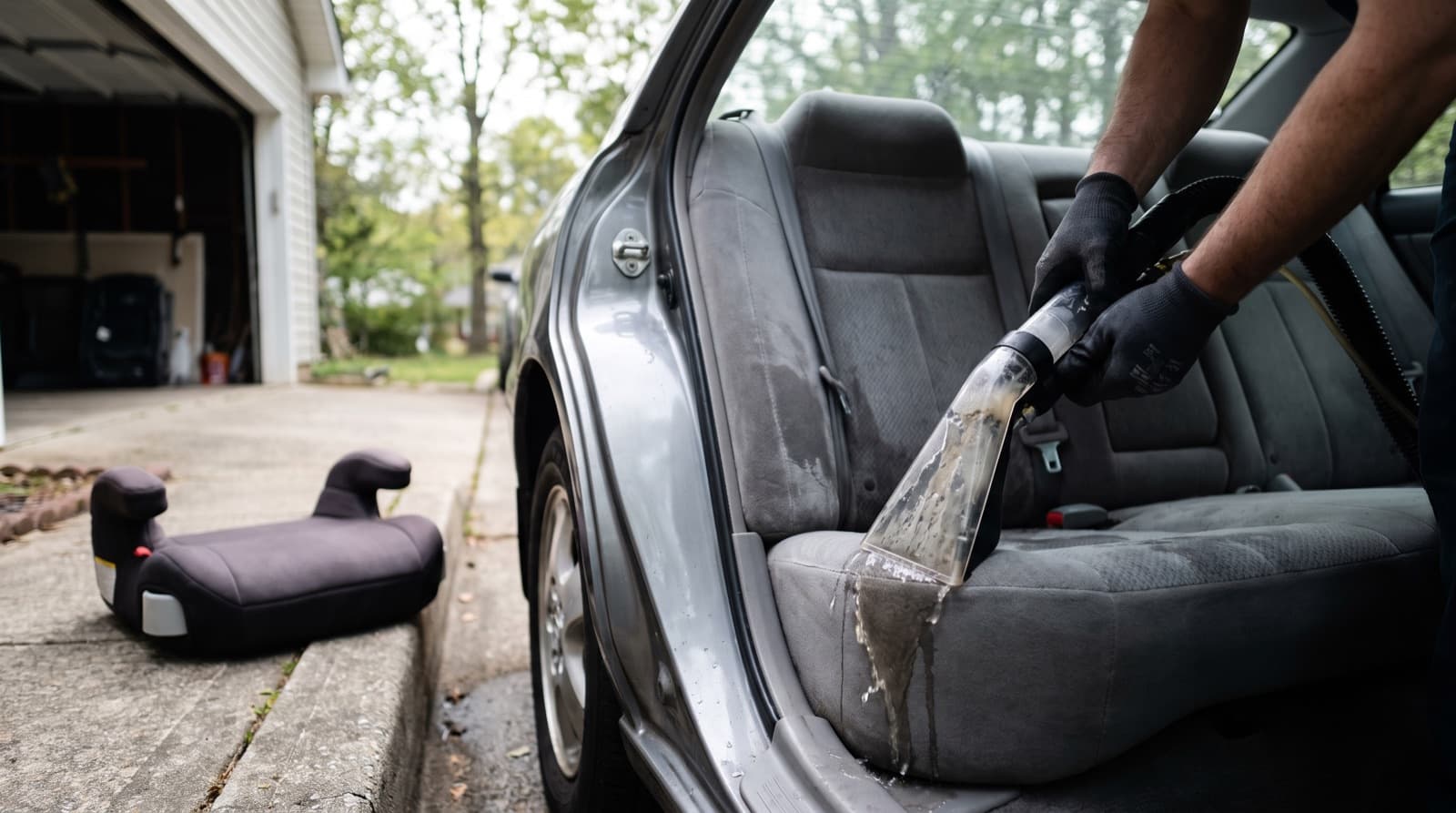
- 4. Extract or blot. Pull the moisture and dead mold back out with a wet/dry or extraction vacuum. If you only have towels, blot hard and swap to dry ones often.
- 5. Steam the stubborn spots. Steam at 200 F or hotter kills what is left in seams, vents, and stitching and lifts staining. Extract again after.
- 6. Dry completely. This is where most people fail. Run fans, crack the windows in dry weather, and let the car sit open in the sun for a full afternoon.
- 7. Re-check in 3 days. If a fuzzy spot returns, you missed either a spore pocket or the water source feeding it.
Killing spores vs. just wiping: what actually works
Here is the honest part. A lot of home remedies make the car look clean while the mold is still alive under the surface. To kill mold you need heat or a product built to break down the organism, and you need it to reach porous foam, not just glide over the top.
This table is how we rank the common options after years of opening up moldy interiors.
| Method | Kills spores? | Best for | Watch-outs |
|---|---|---|---|
| HEPA vacuum | No, removes loose only | The mandatory first step | Won't touch rooted mold; empty outside |
| Enzyme / anti-microbial cleaner | Yes, at the root | Seats, carpet, headliner | Needs full dwell time; test a hidden spot |
| Steam (200 F+) | Yes, heat kills and lifts | Fabric, seams, vents, stitching | Don't soak the foam; extract right after |
| White vinegar | Partially | Light surface mildew only | Sour smell; won't reach deep foam |
| Bleach | Poor on porous surfaces | Hard plastics, not fabric | Bleaches fabric, toxic fumes, skip it |
Pro tip: Bleach is the internet's favorite mold answer and our least favorite. It stains upholstery, its fumes are rough in a closed cabin, and it barely penetrates the porous foam where car mold actually lives. Save it for the garage floor.
Dry the source or the mold comes right back
Killing the mold you can see is only half the job. If the moisture that fed it is still there, you are just resetting a timer. Every job has to end with the car bone dry and the leak fixed.
Track down and fix the water first. Clear clogged sunroof drains, reseal a leaking door or windshield gasket, and replace a cracked weatherstrip. Then dry everything: pull the mats, run a fan across the carpet, and if you live in a fog belt like the Sunset or the Richmond, toss a tub of moisture absorber or a few silica packs under the seats between drives.
A car that dries out fully after every damp morning almost never grows mold. A car that stays 60 percent damp for a week always will.
Pro tip: After cleaning, park in direct sun with all four doors open and the trunk up for a full afternoon. Sunlight and moving air are free, and they finish the kill your cleaner started while pulling water back out of the padding.
When is carpet or foam too far gone?
Sometimes cleaning is not enough, and it is fair to know that going in. Mold sends root-like threads deep into porous material. On a hard surface or a thin fabric you can reach and kill all of it. Inside a thick seat cushion or the jute padding under the carpet, you often cannot.
Consider replacement, not cleaning, when you see these signs. A musty smell that returns within days of a thorough clean means spores survived deep in the foam. Black staining that will not lift, or mold that has spread across a large area of seat foam or carpet padding, usually means that material is saturated. At that point the fix is pulling the carpet and replacing the padding, or re-foaming the seat, which is upholstery work.
There is no shame in that call. Saturated foam is a health hazard you cannot scrub out, and a fresh piece of padding costs less than living with spores.
Frequently Asked Questions
Can you get mold out of a car yourself?
Yes, for small surface mold you can. Vacuum it, kill it with an enzyme or anti-microbial cleaner, agitate, extract the moisture, and dry the car fully while wearing an N95 mask. Go to a pro when the mold covers more than a couple of square feet, keeps returning, or has soaked into seat foam, because that usually needs steam extraction or replacement padding.
Does vinegar kill mold in a car?
Partially. White vinegar can knock down light surface mildew on non-porous spots, but it struggles to reach spores buried in foam and fabric, which is where car mold really lives. For anything more than a light haze, an enzyme cleaner plus steam kills far more reliably. Vinegar also leaves a sour smell you then have to clean out.
Is mold in a car dangerous to your health?
It can be. A sealed cabin concentrates airborne spores, and breathing them can trigger allergies, asthma attacks, coughing, and sinus irritation, especially in kids, older adults, and anyone with a weak immune system. That is why you should always mask up and ventilate before cleaning, and why you should not keep driving a heavily molded car.
Why does my car keep getting moldy?
Because there is still a moisture source you have not fixed. Look for a clogged sunroof drain, a leaking door or windshield seal, wet mats, or a window that gets left cracked. In San Francisco, fog and no-garage parking keep cars damp for days, so the water that feeds mold rarely dries out on its own. Fix and dry the source and the mold stops coming back.
Will car mold go away on its own?
No. Mold does not dry up and disappear, it spreads as long as there is any moisture and food. Leaving it means more spores, a stronger musty smell, and more of the interior it ruins. The sooner you kill it and dry the source, the less you have to replace later.
How much does it cost to remove mold from a car in San Francisco?
It depends on how deep the mold runs. A light surface case folded into a deep interior clean is on the lower end, while heavy mold that needs full steam extraction and drying costs more, and saturated foam that needs replacement adds upholstery labor on top. We give an exact price after you send a few photos, and as a mobile detailer we come to your driveway anywhere in SF, the Peninsula, or Marin.
Keep reading from Golden Bay
Got mold? Let's get it out — and keep it out.
We roll to your driveway anywhere in SF, the Peninsula, or Marin with our own water and power. Text a few photos of the interior and get an exact quote back in minutes — no closed shops, no guesswork.