Problem Solvers
How to Remove Smoke Smell From a Car — Permanently
Key Takeaways
- To remove smoke smell from a car for good, you have to clean the surfaces the smoke soaked into — headliner, seat foam, carpet, and air vents — then neutralize what's left, not spray over it.
- Air fresheners, hanging trees, and 'new car' sprays only mask smoke; the smell returns in a day or two because the source is untouched.
- Smoke residue gets pulled into the HVAC system, so replacing the cabin air filter and cleaning the vents is essential — seat scrubbing alone won't fix it.
- Ozone treatment and thermal fogging reach odor deep in vents and foam, but must be done in an empty car and paired with deep cleaning, not used alone.
- Heavy, long-term smoke saturation can need more than one treatment, and a professional deep interior clean starts around $249 in San Francisco.
To remove smoke smell from a car for good, you have to clean the surfaces the smoke soaked into — the headliner, seat foam, carpet, and air vents — and then neutralize what's left, not just spray over it. Smoke isn't floating in the air. It's baked into every soft, porous part of the cabin. That's why the smell keeps coming back a day after you "clean."
Cigarette, cannabis, and campfire smoke all leave behind sticky, microscopic residue — tar, nicotine, and resin — that clings to fabric and gets pulled deep into the HVAC system every time the car ran with the windows up. A tree-shaped air freshener can't touch any of that.
At Golden Bay Detailing, our technicians have reset a lot of smoke-soaked interiors here in San Francisco, including resale cars people bought sight-unsmelled. Here's exactly what works, what's a waste of money, and when it's worth calling a pro.
Why does smoke smell stay in a car?
Smoke smell stays because the particles are tiny, oily, and sticky. When someone smokes with the windows up, that residue doesn't just land on the dashboard — it gets drawn into the air system and pressed into every fabric surface in the cabin. Wiping the visible plastic barely scratches it.
The smell hides in the places you can't easily reach:
- The headliner (the fabric ceiling soaks up rising smoke like a sponge)
- Seat foam underneath the upholstery
- Carpet and floor mats
- The HVAC evaporator and air vents
- The cabin air filter
- Seat belts and their webbing
- A thin film on the glass and hard plastics
Pro tip: Turn the fan on high with recirculation off and smell the air coming out of the vents. If it smells like an ashtray, the odor is living in your HVAC system — and no amount of seat scrubbing alone will fix that.
Do air fresheners get rid of smoke smell?
No. Air fresheners, hanging trees, and 'new car' sprays add a scent on top of the smoke — they don't remove anything. For a day or two the car smells like pine or vanilla plus smoke. Then the fragrance fades and you're back to just smoke, because the source never left.
Ozone-in-a-can and 'odor bomb' foggers from the auto parts store are weak versions of the real thing and rarely reach the vents or foam. Spending money to mask the smell is the single most common mistake we see.
How to remove smoke smell from a car yourself
If the smoke is light or recent, you can make a big dent at home in an afternoon. Work in this order — clean first, neutralize last — because neutralizing a dirty surface just traps the odor underneath.
- Strip and search. Pull the mats, empty the ashtray, and check under and between the seats for butts, ash, or old debris that's still off-gassing.
- Vacuum everything. Seats, carpet, trunk, seams, and crevices — not just the open floor.
- Wipe the hard surfaces with an all-purpose cleaner (APC). Dash, doors, console, and gently the headliner. Don't soak the headliner; its foam backing holds water and smell.
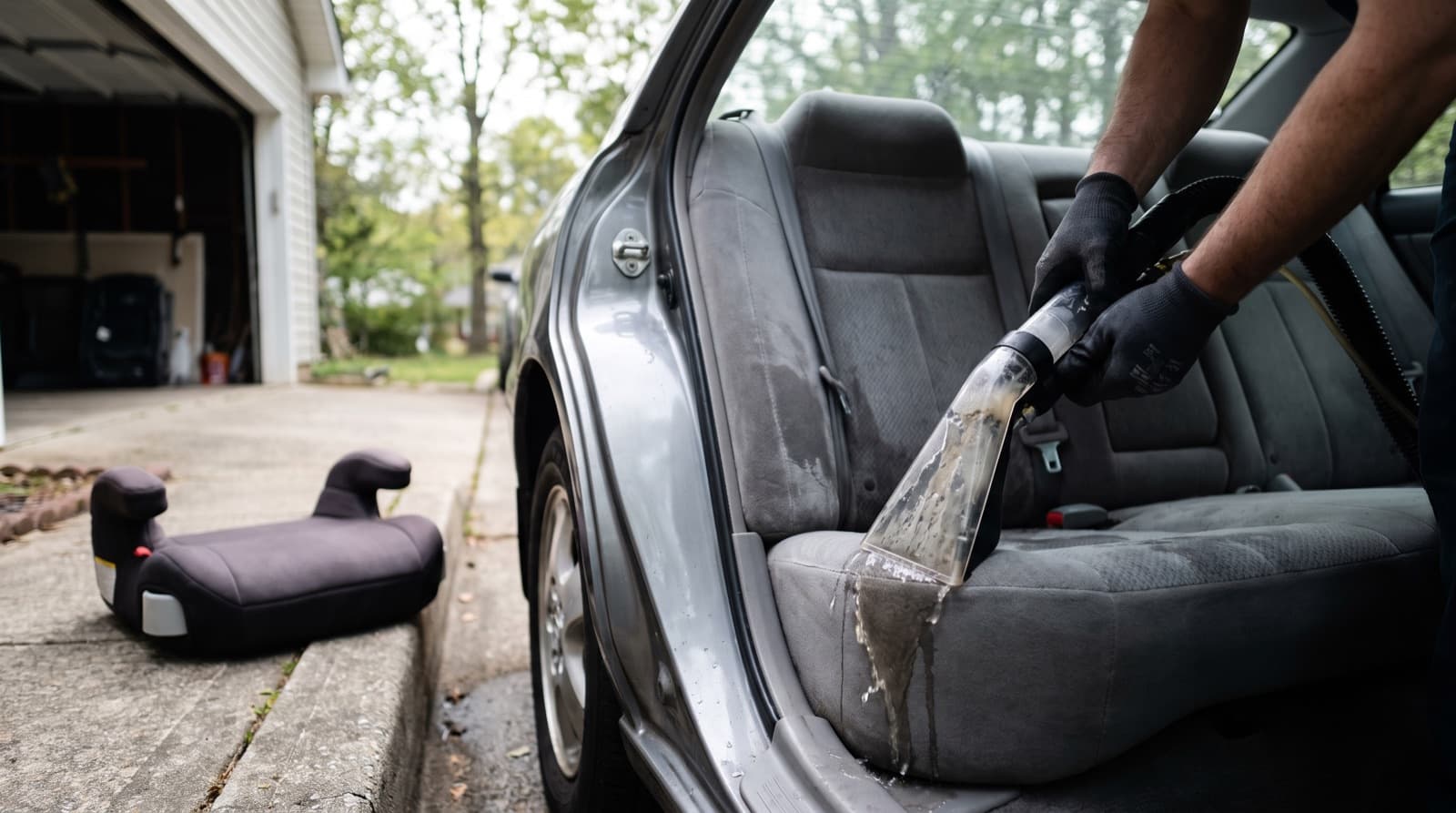
- Shampoo and extract the fabric. A wet/dry vac or spot-extractor pulls residue out instead of pushing it deeper. Steam helps loosen it first.
- Attack the vents. Replace the cabin air filter, then run an HVAC/evaporator foam cleaner with the fan on, cycling from recirculate to fresh air.
- Neutralize the leftovers. Leave activated charcoal bags, a bowl of white vinegar, or baking soda on the carpet overnight; use an enzyme cleaner on any organic source.
- Air it out. Park in the sun with the windows cracked for a few hours.
Pro tip: Replace the cabin air filter first. It's $15–$30, takes about ten minutes on most cars, and it's a hidden sponge for smoke that almost everyone forgets.
Ozone vs. thermal fogging: the heavy artillery
When cleaning gets you 80% of the way and the smell still ghosts back on a warm day, it's living somewhere your rag can't go. That's where the two pro tools come in.
An ozone generator floods the sealed car with ozone (O3), which chemically oxidizes odor molecules wherever air reaches — including deep in the vents. It's powerful, but ozone is a lung and eye irritant, so the car must be empty of people and pets, and you have to air it out well afterward. Thermal fogging heats a deodorizer into a warm, dry fog that follows the exact path the smoke took, settling into foam and ducts — it's especially good on stubborn tobacco. Neither one replaces cleaning. You use them after the physical source is out.
| Method | Best for | What it actually does | Watch out for |
|---|---|---|---|
| Deep clean + extraction | Removing the source | Physically pulls tar and residue out of fabric and carpet | Can't reach sealed vents on its own |
| Ozone treatment | Vent and airborne odor | Oxidizes odor molecules everywhere air flows | Toxic to breathe; empty the car; air out 1–2 hrs |
| Thermal fogging | Deep tobacco smoke | Dry deodorizing fog follows smoke's path into foam and ducts | Needs pro gear; pair with cleaning |
| Air fresheners | Nothing lasting | Covers the smell with fragrance | Source stays; odor returns in days |
Why smoke smell is worse in San Francisco cars
San Francisco is tough on interior odors. The marine layer and near-constant fog keep cabins damp, and moisture reactivates smells — smoke, mildew, and that musty street-parked funk all get louder in a wet interior. If you live in an apartment with no garage, your car sits on the street soaking up cold, damp air every night, so it never fully dries out.
A lot of the smoke jobs we do here are resale cars — someone buys a used Tesla or a commuter sedan and only notices the previous owner smoked once the heater kicks on. Because we're fully mobile and bring our own water and power, our technicians can shampoo, extract, and treat right in your driveway, on the street, or in your office garage. No need to drive a smoky car across town to a shop.
Pro tip: On foggy SF mornings, run the fan on fresh air (not recirculate) for the first few minutes of your drive. Venting the damp cabin cuts the musty-plus-smoke combo that fog makes worse.
When should you call a pro for smoke odor removal?
DIY is genuinely fine for light or recent smoke — one incident, a friend who lit up once, a faint whiff. Do the steps above and you'll likely be happy with the result.
Call a pro when the smell keeps coming back after you clean, when the car belonged to a daily smoker for years, when you just bought a used car and inherited it, or when the odor is clearly in the vents and needs ozone or thermal fog you can't safely run at home. Be realistic: heavily saturated interiors sometimes need more than one treatment, and we'll tell you that honestly upfront rather than promise a miracle. A professional deep interior clean plus an odor treatment runs a few hours and reaches the foam, ducts, and headliner a home vacuum simply can't.
Frequently Asked Questions
Does smoke smell ever come out of a car completely?
Usually, yes — if you remove the physical source and treat the vents, foam, and headliner instead of just the seats. Light or recent smoke often clears in one thorough clean. Years of daily smoking can take multiple treatments, and in extreme cases a faint trace may remain, so an honest detailer will set expectations before starting.
How much does professional smoke odor removal cost in San Francisco?
It's typically booked as a deep interior clean starting from $249, plus a targeted odor treatment on top. Heavily saturated cars are quoted after a quick look or a few photos. At Golden Bay you get an exact text-back quote before any work begins — no surprises.
Will an ozone machine damage my car?
Overusing ozone can degrade rubber seals, leather, and soft plastics over time, so short, correct treatments matter. Never run an ozone generator with people or pets inside — ozone is a lung and eye irritant. Always ventilate the car well before you get back in.
Does baking soda remove smoke smell from a car?
Baking soda helps absorb light residual odor if you leave it on the carpet and seats overnight, then vacuum it up. But it can't reach the vents, foam, or headliner where most of the smell lives. Treat it as a finishing step, not the whole fix.
How long does it take to get smoke smell out of a car?
A solid DIY clean is an afternoon of work plus an overnight airing-out. A professional deep interior clean with an odor treatment usually takes three to five hours. Badly saturated interiors may need a second round of ozone or fogging on another day.
Can you remove smoke smell at my home or apartment in San Francisco?
Yes. We're a fully mobile detailer with our own water and power, so we handle smoke odor removal in your driveway, on the street, or at your office anywhere in San Francisco and down the Peninsula — no travel fee in the standard area. Just text us your situation and we'll bring the whole setup to you.
Keep reading from Golden Bay
Still smelling smoke? Let's fix it for real.
Text a photo and a quick note about the smell — we'll send back an exact quote in minutes, then our technicians bring the steam, extraction, and odor treatment right to your driveway anywhere in SF. — Muza