Problem Solvers
Restore Faded Car Paint Without Repainting: DIY + Pro Fix
Key Takeaways
- You restore faded car paint by machine-polishing off the thin, dead layer of oxidized clear coat with compound and polish, then sealing the fresh finish underneath.
- Oxidation is chalky, dead clear coat caused mostly by UV and neglect; the color usually still lives underneath and is not lost.
- Light fade needs only a one-step polish, moderate fade needs compound first, and clear-coat failure (flaking, exposed color) can only be fixed by repainting.
- Older single-stage cars fade differently than modern clear-coat cars, so the products and technique change.
- After polishing, always seal the paint with a sealant or ceramic coating, or SF sun and salt air will fade it again.
You restore faded car paint by machine-polishing away the thin, dead layer of oxidized clear coat, then sealing the fresh finish underneath — no repaint needed, as long as the fade has not cut all the way through to the color or primer. Chalky, sun-baked paint is one of the most common problems we see on older San Francisco cars, and most of the time it is fixable in an afternoon.
Oxidation looks permanent, but it usually is not. The color did not disappear. It is hiding under a rough, weathered surface layer. Remove that layer the right way and the gloss comes back.
This guide covers what oxidation actually is, the compound-and-polish method that fixes it, how single-stage and clear-coat cars differ, when paint is genuinely too far gone, and how to lock in the result so it lasts.
What Is Oxidation, and Why Does Car Paint Fade?
Oxidation is what happens when UV rays and air break down the top layer of your paint. On modern cars that top layer is clear coat, and as it dies it turns hazy, dull, and chalky to the touch. On older single-stage cars the color itself oxidizes, which is why a red car fades to a pale pink and a black car goes gray.
The fade almost always starts on horizontal panels — the hood, roof, and trunk — because they take the most direct sun. Vertical panels like doors usually stay glossier longer, which is a good clue that you are dealing with oxidation and not a paint defect.
- Sun and UV exposure, especially with no garage
- Salt air and marine moisture near the coast
- Bird droppings and tree sap left to bake in
- Years with no wax, sealant, or protection
- Harsh brush car washes that scour the surface
Can You Fix Faded Paint Without Repainting?
In most cases, yes. Polishing removes a few microns of dead clear coat to reveal the healthy, glossy paint below. The catch is depth — clear coat is only about as thick as a sheet of paper, so there is a limit to how much you can remove before you hit the color underneath.
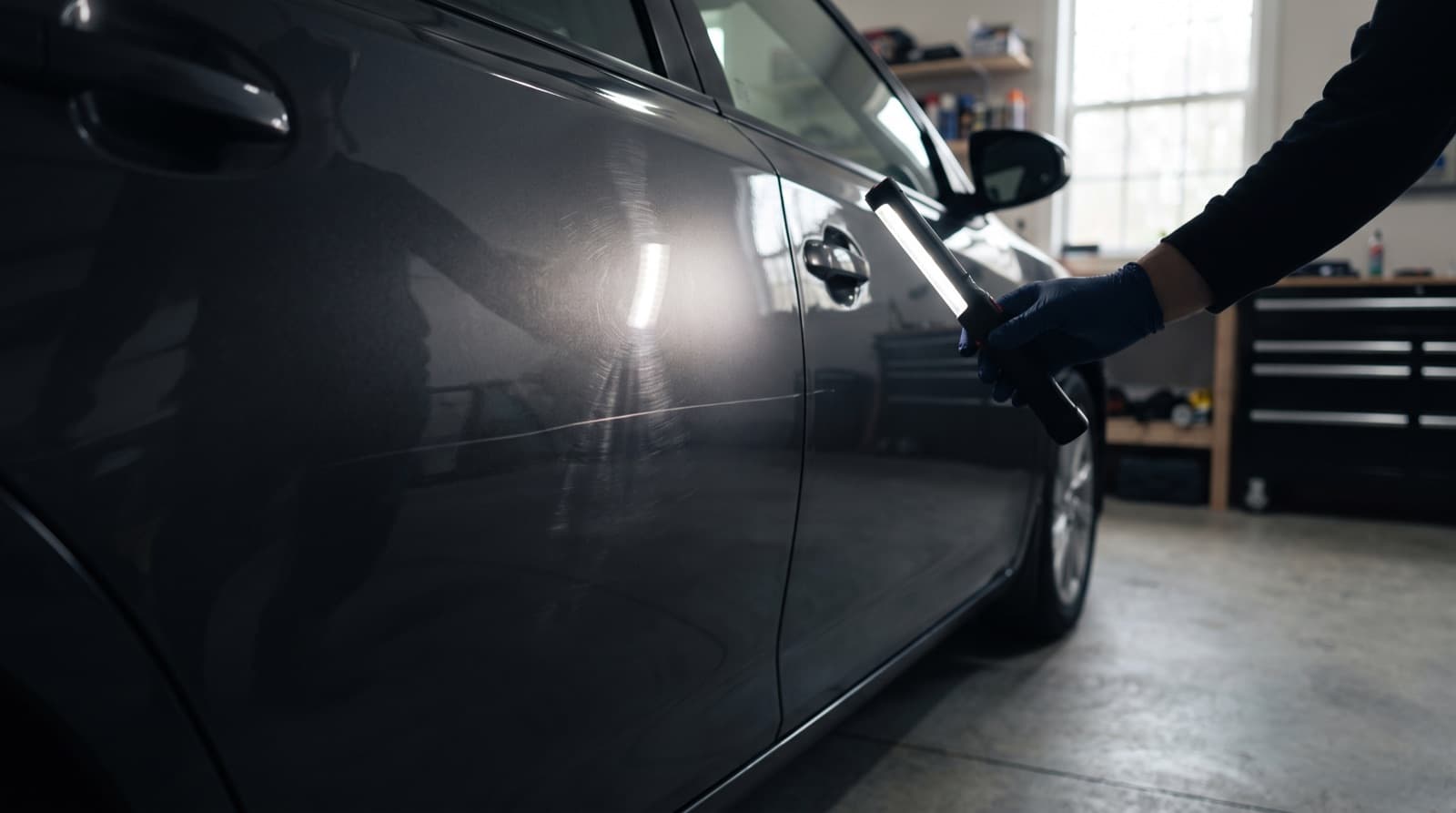
The right fix depends entirely on how far the oxidation has gone. Rub a clean microfiber across the panel: if it comes away with a chalky white or gray residue, the surface is dead but often still saveable. Use the guide below to size up the job before you touch it.
| Paint condition | What you see and feel | The fix |
|---|---|---|
| Light oxidation | Dull sheen, faint haze, minor water spots | One-step polish restores the gloss |
| Moderate oxidation | Chalky feel, flat color, faded panels | Compound first, then polish |
| Heavy oxidation | White or gray chalk, rough surface | Wet-sand plus compound, or a pro correction |
| Clear coat failure | Cloudy patches, flaking, exposed color | Repaint — polishing cannot rebuild clear coat |
What You Need to Restore Faded Paint
You can fix light fade by hand, but real oxidation needs a machine to break down the compound and generate the correct heat and friction. A dual-action (DA) polisher is the safe choice for beginners because it is far less likely to burn through an edge than a rotary.
Buy quality abrasives — cheap compound leaves swirls that you then have to chase out. Trusted names include Meguiar's Ultimate Compound, Griot's, Menzerna, and Sonax.
- A dual-action polisher (Griot's, Rupes, or similar)
- A cutting compound for the heavy oxidation
- A finishing polish to refine the gloss
- Foam cutting and polishing pads
- A stack of clean microfiber towels
- Isopropyl alcohol (IPA) to wipe down and check your work
- A sealant, wax, or ceramic coating to finish
Pro tip: Pro tip: always start with the least aggressive combo that works — polish and a soft pad first. Only step up to compound and a cutting pad if the polish alone will not clear the haze. You can always cut more; you cannot put clear coat back.
How to Restore Faded Car Paint, Step by Step
The order matters more than the products. Skipping the wash or the test spot is how people put swirls into paint they were trying to save.
Work one panel at a time, in the shade, on a cool surface. Sun bakes the compound onto the paint and makes a mess.
- Wash and dry the car fully — grit under your pad will scratch
- Do a small test spot to confirm your product and pad combo works
- Apply a few pea-sized dots of compound to the pad
- Spread it at low speed, then work it in at medium speed with light pressure
- Overlap slow passes until the compound goes clear
- Wipe the residue and inspect the gloss
- Follow with finishing polish to remove any haze
- Do an IPA wipedown so you see the true, unwaxed finish
Single-Stage vs. Clear-Coat Paint: Know What You Have
This step saves older cars. Most vehicles built after the 1990s use a two-stage system: a color base coat sealed under a clear coat. When you polish these, your towel stays the paint's color-free — you are only cutting clear.
Older cars, classics, and some work trucks use single-stage paint, where the color and the gloss are the same layer. Polish one of these and your pad picks up the actual color. That is normal, but it means every pass removes real color, so you go gentle and stop sooner. San Francisco has a lot of these older survivors, and they respond beautifully to a careful hand — right up until they don't.
Pro tip: If your pad comes away tinted the car's color, you are on single-stage paint. Ease off the compound, use a milder polish, and check often — there is no clear coat safety margin to protect you.
When Paint Is Too Far Gone for Polishing
Polishing restores paint that is dull. It cannot fix paint that is failing. If the clear coat is peeling, flaking, or has turned milky white in patches, that layer has delaminated and no amount of compound will bring it back — those spots need to be repainted.
The same goes for fade that has already worn through to primer or bare metal. Once you see a flat, faded patch that is a different color than the panel around it, you are past detailing and into body-shop territory. An honest detailer will tell you that up front instead of selling you a correction that cannot work.
Seal It, or SF Will Fade It Again
Polishing strips off every bit of old protection along with the oxidation, which leaves your fresh paint bare and vulnerable. If you stop there, San Francisco's marine layer, coastal salt air, and unshaded street parking will start the fade all over again within months.
Lock in the result with protection. A carnauba wax lasts a couple of months, a paint sealant runs six months to a year, and a professional ceramic coating protects for years while making the paint far easier to keep clean. For a car you just spent hours restoring, the coating is the move that makes the work last.
Frequently Asked Questions
Does polishing remove clear coat?
Yes, but only a tiny amount. Cutting compound removes a few microns of the dead top layer to reveal healthy paint underneath. Clear coat is very thin, so you should never over-polish the same panel, and you should always start with the mildest product that gets the job done.
Can I restore faded paint by hand?
You can improve light haze and minor dullness by hand with a good compound and plenty of elbow grease. But real oxidation needs a machine polisher to generate the heat and friction that break the abrasives down properly. By hand you will wear out before you ever cut through moderate or heavy chalking.
How much does it cost to restore faded paint versus repainting?
A paint correction is a fraction of the cost of a repaint. Machine polishing revives paint you already own, while a quality repaint of even a few panels runs into the thousands at a body shop. As long as your clear coat is oxidized but not failing, polishing is by far the cheaper fix.
Will the fade come back after I polish it?
Only if you leave the paint unprotected. Polishing removes the old wax and sealant along with the oxidation, so the fresh surface is exposed. Seal it with a sealant or ceramic coating and keep up with washing, and the gloss will hold for years instead of fading again in a season.
Do you restore faded paint at my home in San Francisco?
Yes. Golden Bay Detailing is fully mobile — we bring our own water and power to your driveway, office, or street spot anywhere in San Francisco, the Peninsula, and Marin. We are System X certified and handle everything from a one-step polish on a daily driver to full multi-stage correction on older SF survivors.
Keep reading from Golden Bay
Bring the gloss back to your faded paint
Get a free, honest quote from Golden Bay Detailing. We come to you anywhere in SF, the Peninsula, or Marin — and we will tell you straight whether your paint can be polished or needs more.