Compare & Choose
Tesla Paint Protection: PPF, Ceramic Coating or Both?
Key Takeaways
- For a Tesla, paint protection film (PPF) is the tool for rock chips, because the film takes the hit.
- A ceramic coating helps Tesla paint with UV, gloss and easy washing, but it cannot stop rock chips.
- A common setup is front-end film from a film installer plus a ceramic coating on the rest of the paint.
- Daily Bay Area freeway commuters on 101 or 280 get the most from front-end film. City-only drivers often need just a coating.
- Golden Bay Detailing installs ceramic coatings from $799, not film, across San Francisco, the Peninsula and Marin.
Tesla paint protection uses two tools: film for rock chips, and a ceramic coating for gloss, UV and easy washing. Some owners use both, with film on the front end and a coating on the rest of the paint. Golden Bay Detailing installs ceramic coatings, but we do not install film.
That gives us a fair view. Many new-car owners are pitched film around delivery day. Sometimes it is the right call, and sometimes a coating alone is enough. It depends on how and where you drive.
This guide covers painted models like the Model 3, Model Y, Model S and Model X. The Cybertruck's steel body has no paint, so it is a different story. We are an independent detailer, not affiliated with Tesla.
Tesla PPF vs ceramic coating: what does each one do?
Paint protection film, or PPF, is a thick, clear film stuck onto the paint. It works like a screen protector for your car. When a small stone hits, the film takes the blow instead of the paint.
A ceramic coating is a liquid that hardens into a thin, glassy layer. It bonds to the clear coat (the clear top layer of your paint). It is far too thin to stop a rock. Its job is to keep paint glossy, shed dirt and water, and slow damage from sun and grime.
Our ceramic coating vs PPF guide covers the general matchup. Our posts on whether PPF is worth it and whether a coating prevents scratches go deeper. This page stays on one question: what makes sense for a new Tesla or other EV.
- Film: the best way to stop rock chips on the bumper, hood and mirrors
- Film: on many modern films, light swirls in the top layer fade with warmth
- Coating: helps shield paint from UV rays that fade and dull it
- Coating: resists bird droppings, sap and bug guts, so they take longer to etch in
- Coating: water beads and rolls off, so washing is faster
- Both: neither one makes paint immune to scratches, dents or door dings
Where do Tesla paint chips come from, and do you need PPF?
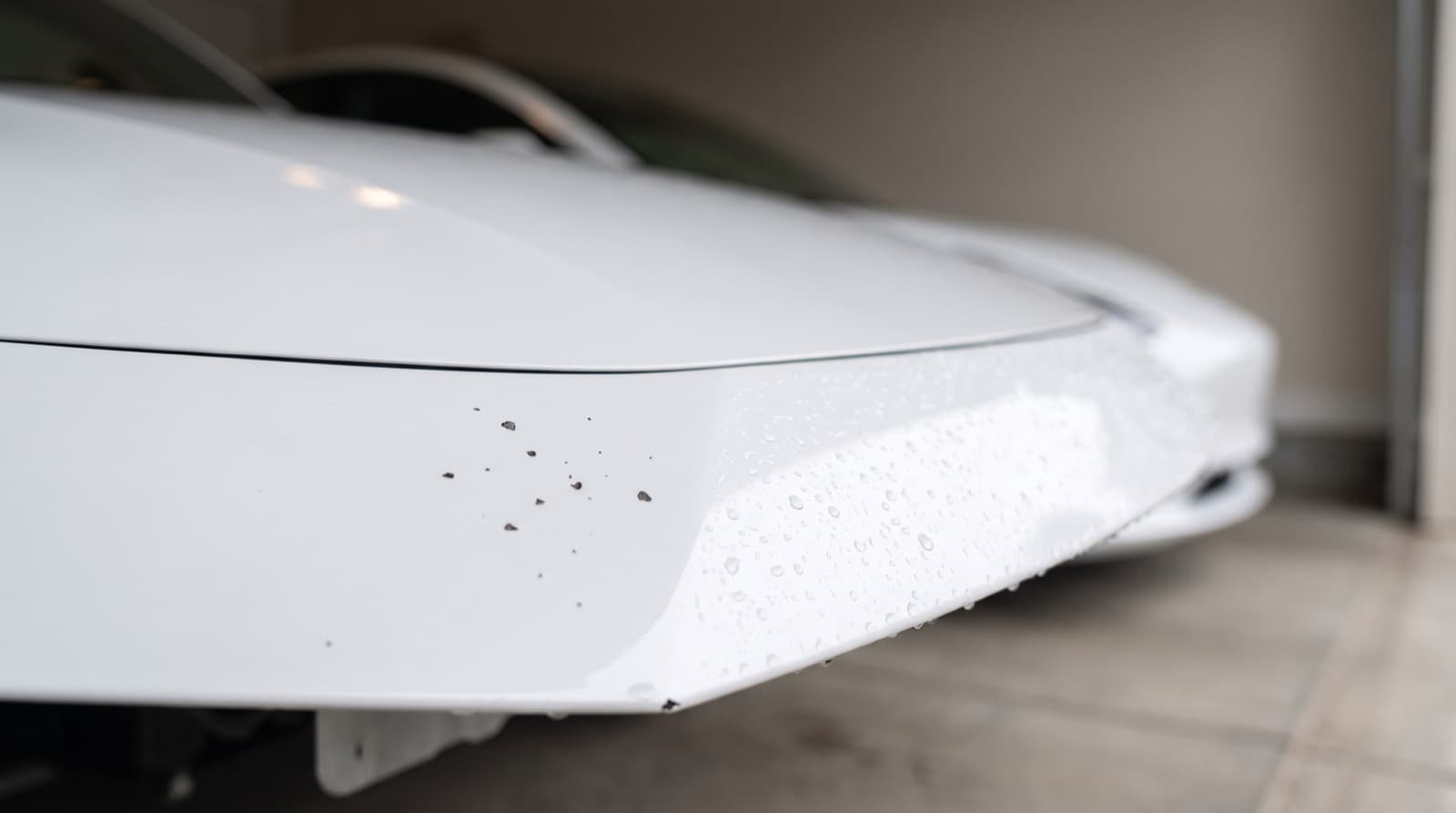
Tesla paint chips come from the same place as chips on any car. Tires ahead of you throw up small stones. A pebble hits much harder at 65 mph than at 25 mph. A Model 3 or Model Y takes those hits like any other car.
Chips land on the parts that face the road. That means the front bumper, the hood edge, the mirrors and the area behind the front wheels.
So do you need film? If most of your miles are on the freeway, front-end film is worth a serious look. If you mostly drive in the city, a coating alone is often enough.
Front-end film comes in two common sizes. Partial front covers the bumper, mirrors and the front part of the hood and fenders. Full front covers the whole hood, the full front fenders, the bumper and mirrors, and often the headlights.
How long film lasts depends on the film and the installer. Ask the installer what their warranty covers before you book.
Rivian owners asking about PPF can use the same logic. Our detailing-by-vehicle page covers other makes.
Pro tip: If you only film part of the car, start with the front bumper, hood edge and mirrors. Those spots take most of the chips.
Which Tesla paint protection fits how you drive?
Use this table as a starting point. Find the row that sounds most like you.
Two things can shift the answer. If you plan to keep the car for many years, lean toward more protection. If you park outside under trees, the coating matters more than film.
| How you drive | Biggest paint threat | Front-end film? | Ceramic coating? |
|---|---|---|---|
| City only, street parked in SF | Sun, bird droppings, sap, fog spots, wash marks | Optional | Yes, as your main protection |
| Daily 101 or 280 commuter | Rock chips on the bumper, hood and mirrors | Strongly consider | Yes, on the paint without film |
| Short lease (2 to 3 years) | Wear and grime before turn-in | Only with heavy freeway miles | Entry 2 to 3 year coating |
| Long-term owner with road trips | Chips plus years of sun | Strongly consider | Longer-lasting tier on the paint without film |
| Garage kept, light weekend use | Dust and wash marks | Usually not needed | Yes, for gloss and easy washing |
Can you have both PPF and a ceramic coating?
Yes. A common setup is front-end film from a film installer plus a ceramic coating on the rest of the paint. The film handles chips, and the coating handles gloss and easy washing.
Order matters. Film usually goes on first, because film does not stick well to a coated surface. Plan the film visit before the coating visit.
If your car already has film, tell us when you ask for a quote. We will look at the car and tell you what we recommend.
What should you check on new car paint at delivery?
Any new car can pick up marks between the factory and your driveway. It rides on trucks, sits in lots and gets wiped by many hands. This checklist works for any brand.
- Look at the car in daylight, not only under showroom or garage lights.
- Shine your phone flashlight at a low angle on each panel. Swirls show up as fine circles or spider webs.
- Check the front bumper, hood edge and mirrors for tiny chips.
- Check the lower doors and the area behind each wheel for chips and scuffs.
- On clean, dry paint, put your hand in a thin plastic sandwich bag and glide it over the surface. Rough spots mean stuck grit that a clay bar (a soft clay that pulls grit off paint) can remove.
- Check all the glass, including the windshield, for chips.
- Take photos of anything you find, and point it out before you sign for the car.
When should you protect a new Tesla, and in what order?
The best time is soon after delivery. That is before the first freeway chips, and before a careless wash leaves swirls. Film and coatings are clear, so they lock in whatever is under them.
Our entry coating, from $799, includes a 1-step correction, which is one round of polishing. That clears most light marks on newer paint. Deeper scratches can need more steps, and we quote that after we see the paint.
- Step 1: Inspect the paint with the checklist above.
- Step 2: Touch up chips that reach bare metal. Film or a coating over a chip seals it in, and you can still see it.
- Step 3: Fix swirls with paint correction (machine polishing that levels out fine scratches).
- Step 4: If you want film, have a film installer put it on.
- Step 5: Add the ceramic coating to the paint that has no film.
How much does paint protection cost at Golden Bay?
We only install coatings, so here are our coating prices. For film prices, ask a film installer. Our prices are starting points, and the final quote depends on paint condition.
After install, keep the car dry the first night. Then do not wash it for 10 to 14 days while the coating cures. After that, use a hand wash or a touchless wash only. A brush tunnel wash voids our coating warranty, and the warranty does not transfer if you sell the car.
- From $799: a 2 to 3 year coating, with a 1-step paint correction included
- From $1,499: our 6-year coating tier
- $2,499 and up: our flagship coating
- SUVs and trucks add $200 on any coating. Ask us whether your model prices as a sedan or an SUV.
- Ceramic Maintenance Detail: $250 sedan or $300 SUV, once a year, required to keep the warranty
Pro tip: If you can, book your coating in a dry stretch. The 10 to 14 day no-wash window is easier when it is not raining.
How does Bay Area driving change the choice?
Where you live and park in the Bay Area shapes your risks. Here is what our technicians watch for.
- Freeway commutes on 101 and 280: the most chips, especially behind trucks and near road work.
- Fog and marine layer: fog wets the car, then sun dries it into spots. A coating helps those spots rinse off.
- Salt air near Ocean Beach, the Marina and Sausalito: a salty film settles on paint. Rinse it off often.
- Street parking under trees: bird droppings and sap land daily. A coating buys you time to clean them off.
- Tight apartment garages and street spots: door dings and scuffs. Neither front-end film nor a coating stops these.
- Beach sand in Pacifica and Half Moon Bay: wind-blown grit scratches when you wipe it dry. Always rinse first.
- Rain season: the first storms splash oily road grime up the sides. Coated paint rinses clean faster.
What can you do yourself, and when should you call a pro?
Good habits protect any paint, with or without film or a coating. These steps are safe at home.
Call a pro when you see swirls or haze that washing won't fix. Call one when you want a coating that lasts for years, since the paint needs polishing first. For lots of chips or for film, see a body shop or a film installer.
Our technicians come to your home, office or apartment garage. A coating takes a full day, so we book it ahead.
- Hand wash with two buckets, one soapy and one to rinse your mitt, or use a touchless wash.
- Skip brush tunnel washes. The brushes drag grit across the paint.
- Rinse sand and dust off before a mitt ever touches the car.
- Dry with a clean, plush microfiber towel or a blower.
- Clean off bird droppings and sap the same day with a quick detail spray and a soft towel.
- Add a spray sealant every month or two if the car has no coating.
Frequently Asked Questions
Does a ceramic coating stop rock chips on a Tesla?
No. A coating is far too thin to absorb a rock strike. Paint protection film is the tool for chips, while a coating helps with UV, gloss and easy washing.
Does a Tesla Model Y need PPF?
It depends on how you drive, not on the model. If you commute on the freeway every day, front-end film is worth a look. If you mostly drive in the city, a coating alone is often enough.
Should PPF or ceramic coating go on first?
Film usually goes on first, since film does not stick well to a coated surface. If your car already has film, mention it in your quote request. We will tell you what we recommend.
Do I need paint protection on a leased Tesla?
Not always. For a 2 to 3 year lease, an entry coating matches the term and keeps washing easy. Add front-end film only if you drive heavy freeway miles.
Does Golden Bay Detailing install PPF?
No, we do not install film. We come to you and install ceramic coatings from $799, with a 1-step paint correction included. We serve San Francisco, the Peninsula and Marin, plus Palo Alto and parts of the East Bay for coatings.
Keep reading from Golden Bay
Want your Tesla's paint protected the right way?
Get a free ceramic coating quote. Our entry coating, from $799, includes a 1-step paint correction. We come to your home, office or garage in San Francisco, the Peninsula and Marin.