Problem Solvers
How to Get Scratches Out of a Car: A Fast Fix Guide
Key Takeaways
- To get scratches out of a car, do the fingernail test first: if your nail does not catch in the scratch, it is a light clear-coat mark that usually polishes out at home.
- Light clear-coat scratches and swirls come out with a scratch-remover polish or a machine buff; deeper scratches you can feel need touch-up paint.
- If you see white, gray, or bare metal in the groove, the scratch is past the paint and needs a body shop, not polish.
- A DIY scratch-remover kit costs about $15 to $25 and works only on clear-coat scratches; it cannot fix a scratch your fingernail catches on.
- Always wash and dry the panel before working a scratch, and buff in the shade so you can see the true result.
To get scratches out of a car, first find out how deep the scratch is, then match it to the right fix: polish or a scratch remover for light clear-coat marks, touch-up paint for deeper ones, and a pro or body shop for anything past the paint. Depth decides the fix, not how bad the scratch looks.
Good news: most scratches that make people wince are shallow clear-coat marks. Those come out in your driveway with a $15 bottle and ten minutes. The trick is knowing which scratches are worth your time and which will only get worse if you keep rubbing them.
At Golden Bay Detailing here in San Francisco, our technicians have corrected paint on 500-plus cars. Here's the fast, honest path from "is this even fixable?" to a smooth panel.
Will this scratch even come out? Do the depth test
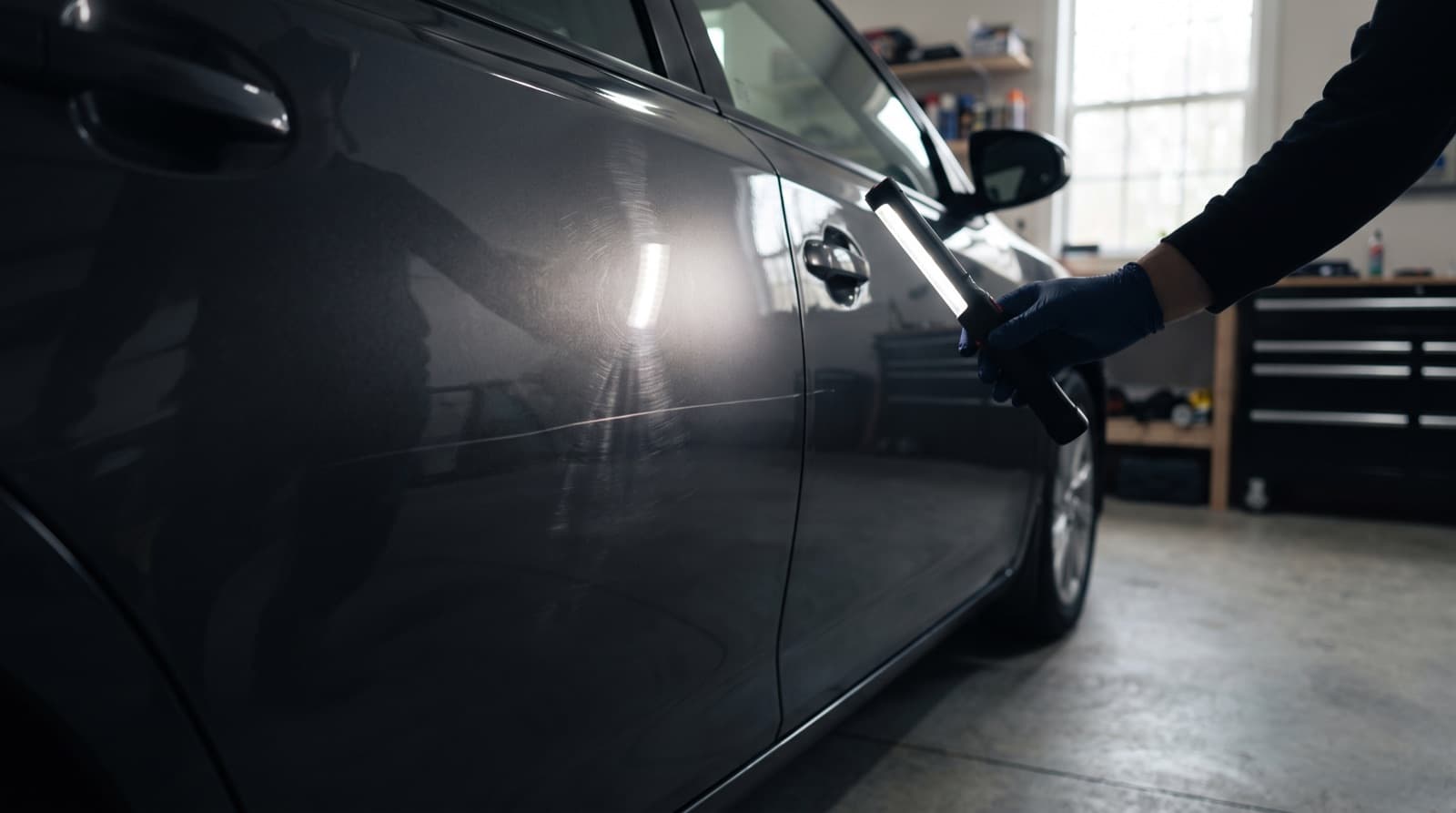
Before you buy anything, run the fingernail test. Wash the spot, dry it, then drag a fingernail lightly across the scratch. What your nail does tells you the fix.
This 30-second check saves you money. It stops you from buying polish for a scratch that actually needs paint, or driving to a body shop for a mark that wipes out with compound.
- Nail glides over with no catch: clear-coat scratch. Polish or a scratch remover will very likely take it out.
- Nail lightly catches: it reached the color coat. Polishing may fade it, but expect to touch it up.
- Nail drops into the groove, or you see white, gray, or metal: it is past the paint and needs touch-up paint or a body shop.
Pro tip: Test in the shade, never direct sun. Bright light hides fine scratches and makes deep ones look shallower than they are. We've watched people 'fix' a scratch that reappeared the second the car rolled into the garage.
Match the scratch to the right product
Once you know the depth, buy for that depth. The wrong product wastes money and can add haze. Here is what each option actually fixes and what it costs.
| Option | What it fixes | Rough cost | Effort |
|---|---|---|---|
| Scratch-remover polish (by hand) | Light clear-coat scratches, swirls | $15 to $25 | 10 to 20 min, easy |
| Rubbing compound + polish | Deeper clear-coat scratches, oxidation | $25 to $40 | 30 to 45 min, moderate |
| Machine buff (DA polisher) | Swirls, most clear-coat scratches, full panels | $120+ tool, or a pro | 1 to 3 hrs, skill needed |
| Touch-up paint | Scratches through the color to primer or metal | $20 to $40 | Slow, patience needed |
| Body shop or pro correction | Deep scratches, dents, cracked clear coat | $150+ | Drop-off or mobile pro |
How to get a light scratch out, step by step
This is the driveway fix for a clear-coat scratch, the kind your fingernail glides over. Work in the shade on a cool panel.
- 1. Wash and dry the area. Grit trapped in the scratch will add new scratches the moment you rub.
- 2. Put a dime-size dab of scratch remover or polish on a clean foam or microfiber applicator.
- 3. Work it into the scratch with firm pressure, in small back-and-forth passes, for 30 to 60 seconds.
- 4. Wipe the spot clean with a fresh microfiber towel and check it in the shade.
- 5. Repeat two or three times if the scratch is fading. If it looks the same after three rounds, it is too deep for polish, so stop and switch to touch-up.
Pro tip: Less product, more passes. People glob on polish thinking it works harder, but it just slings everywhere and hides your result. A thin film and steady pressure is what cuts the clear coat evenly.
When to use touch-up paint instead
If your fingernail catches and you can see color loss or a lighter primer layer, polish will not save it. Now you are filling and hiding the scratch, not buffing it, and touch-up paint is the DIY move.
Get the exact paint code first. It is on a sticker in the driver's door jamb, usually a three-to-five character code. Order the matching pen or bottle, clean the scratch, and apply thin coats with a fine tip, letting each one dry.
- Build the paint up in thin layers until it is just level with the surface. Thick blobs look worse than the scratch.
- Let it fully cure for a day or more, then lightly level and polish it if you want it smoother.
- Touch-up hides deep scratches; it rarely makes them vanish. Up close you will still see it, but from a step back it disappears.
Pro tip: On a black or dark car, touch-up almost always shows a little. If the scratch is on a hood or door you'll stare at daily, a pro respray of the panel is the only truly invisible fix.
When to call a pro (and skip the DIY)
DIY has a real ceiling, and pushing past it usually makes things worse. Here is where we tell people to stop and hand it off.
Machine paint correction is the real fix for swirls and shallow scratches at scale. It removes a micro-thin layer of clear coat to level the surface, and it is easy to burn through if you have never done it. That is a job worth paying for.
- The scratch shows white, gray, or bare metal. That is primer or steel, and open metal can rust if you leave it.
- There are deep scratches across a whole panel, or a car's worth of swirls you want gone for good.
- You want a flawless, no-trace finish on a dark or high-value car.
- The 'scratch' is actually a transfer, another car's paint or a rubber scuff. Those often wipe off with compound, and a pro can tell in seconds.
Why San Francisco cars get scratched (and how to stop it)
If you park on the street here, you already know the drill: tight spots, door dings, shopping carts, and the occasional keying. Add fog and marine-layer grit that settles on the paint, and every careless wipe drags that grit across your clear coat like sandpaper.
Most 'scratches' we see on SF cars are actually wash marring, fine swirls from wiping a dusty car with a dry rag. The real fix is prevention: rinse first, use a clean microfiber, and never dry-wipe salt-air dust.
- Rinse before you wipe. SF fog leaves a gritty film that scratches paint when it is dry.
- Keep one clean microfiber for glass and a separate one for paint.
- A ceramic coating adds a harder, slicker layer that resists light scratching and makes grime rinse off easier.
Pro tip: We're mobile, so our technicians fix a lot of these in the customer's own driveway or office parking spot. They bring the water and power, do the correction on-site, and there's no trip to a shop. Street-parked cars in the Sunset and Richmond are our bread and butter.
Frequently Asked Questions
Can toothpaste really get scratches out of a car?
Toothpaste has a mild abrasive, so it can lightly buff a very shallow clear-coat scuff. But it is weak and inconsistent, and it can leave its own haze. A $15 scratch-remover polish is made for the job and works far better, so skip the toothpaste unless it is all you have.
Will a scratch remover work on a deep scratch?
No. Scratch removers and polishes only cut the clear coat. If your fingernail catches in the scratch, or you can see color or primer, no amount of polishing will fill it. That level of damage needs touch-up paint or a body shop.
Does WD-40 get scratches out?
WD-40 only fills the scratch temporarily and makes it look better while wet. It wipes off and the scratch comes right back, and the oily film attracts dust. Use it to check whether a mark is a real scratch or a wipe-off transfer, not as a repair.
How much does professional scratch removal cost?
It depends on depth and how many panels are involved. A single-panel polish is affordable, while full paint correction at Golden Bay runs $399 for one step, $799 for two step, and $1,199 for multi-stage. Deep scratches that need paint are body-shop work.
Is it safe to buff scratches out myself?
By hand with a scratch-remover polish, yes. It is very hard to hurt your paint that way. The risk comes with a machine buffer, where too much pressure or heat can burn through the clear coat. If you are new, stick to hand polishing or hire a pro for machine work.
Keep reading from Golden Bay
Not sure if it'll buff out? Let us take a look.
Send a photo and we'll tell you straight: DIY polish, touch-up, or real correction. We come to your driveway anywhere in SF and the Peninsula. Grab a free quote.