Problem Solvers
Is Ozone Treatment Safe for Cars? Risks and Real Uses
Key Takeaways
- Ozone treatment is safe for cars when the vehicle sits completely unoccupied during the cycle and airs out with the doors open for 30 to 60 minutes afterward.
- Ozone destroys odor by oxidizing the molecules that cause it, so smells do not return the way they do with air fresheners, and the gas reaches headliner foam, seat foam, and HVAC ducts that liquid cleaners cannot.
- Ozone is a lung irritant. OSHA limits worker exposure to 0.1 parts per million averaged over an eight-hour day, so no person, pet, or plant should be inside during a treatment.
- Overexposure degrades rubber seals and strips the oils and plasticizers out of leather and vinyl, so two short 30 to 60 minute cycles beat one overnight blast.
- Ozone does not clean. If nicotine film, urine, spilled milk, or a food source is still in the car, the odor returns within days, which is why extraction and deep cleaning have to come first.
Ozone treatment is safe for cars as long as the car is empty while the machine runs, the cycle stays short, and the interior airs out before anyone sits in it. The danger is almost never the equipment. It is the person who leaves a generator running all night, or hands the keys back twenty minutes after shutting it off.
Ozone is one of the few tools that actually removes an odor instead of covering it. It is also an aggressive oxidizer and a respiratory irritant, which means it deserves respect rather than fear.
Here is what ozone genuinely fixes, what it can damage, why cleaning has to happen first, and how it compares to enzyme cleaners and thermal fogging.
So is ozone treatment safe for cars, or not?
Ozone, or O3, is safe for the car and unsafe for you. Those two facts sit side by side, and separating them clears up most of the confusion online.
For people, ozone is a lung irritant. OSHA caps worker exposure at 0.1 parts per million over an eight-hour shift, and a detailing generator puts out far more than that inside a sealed cabin. Run it in an empty car with the doors shut and there is no exposure at all. Sit in the car while it runs and you are breathing something that inflames airway tissue, which matters even more if you have asthma.
For the car, the risk is dose and duration rather than the treatment itself. One or two controlled cycles will not hurt an interior. Running a machine for eight hours because more sounds better can leave you with chalky trim and brittle window seals.
So the honest answer splits in two. Safe for people means never occupied and always aired out. Safe for materials means short cycles instead of marathons.
How does ozone destroy odor instead of masking it?
An air freshener adds a scent on top of a smell. Ozone removes the smell. That difference is why ozone still earns its place in professional detailing despite the handling rules.
Ozone is an oxygen molecule with a third atom hanging on loosely. That third atom breaks away and latches onto whatever it touches, including the sulfur compounds in cigarette tar, the volatile acids in spoiled milk, the mercaptans in skunk spray, and the byproducts of mildew. Once a molecule is oxidized its shape changes, and your nose no longer reads it as an odor. Nothing is left behind to reactivate later.
Because ozone is a gas, it also travels where sprays and shampoos never reach. It gets into headliner foam, down through seat cushions, along the HVAC ducts, and behind the dash. That reach is exactly why it works on smoke, which soaks into every porous surface in a cabin.
What is ozone genuinely good for?
Ozone earns its keep on odors that have absorbed into the car rather than sitting on top of it. If you can point at the source and throw it away, you do not need ozone at all.
These are the jobs where it does real work:
- Cigarette and cannabis smoke that has soaked into the headliner, foam, and vents
- Musty and mildew smells from a leaking sunroof, a cracked window in the rain, or damp carpet padding
- Biological messes after the source is gone: vomit, urine, blood, spilled milk, a forgotten bag of groceries
- Skunk or dead-animal odor pulled in through the fresh air intake
- Long-stored, flooded, or estate-sale cars that smell like a basement
Pro tip: Our technicians pull the cabin air filter before an ozone cycle and install a fresh one afterward. That filter holds the exact odor you are treating, and leaving it in place will re-scent the whole car within a week. They also run the HVAC on recirculate with the fan low for part of the cycle so the ozone actually travels the ductwork.
What can ozone damage, and how long is too long?
Ozone attacks odor molecules through oxidation, and it does not stop to check what else is nearby. Over long or repeated exposure, the same chemistry goes to work on parts of your interior.
Most cheap consumer generators have no timer and no output rating you can trust, so people default to leaving it overnight. That is the single most common way an ozone treatment goes wrong. A mild musty smell usually needs 20 to 30 minutes, and a moderate odor needs 30 to 60. Heavy smoke does better with two or three separate sessions, with cleaning and airing out between them, than with one enormous blast.
Airing out matters as much as run time. Ozone breaks back down into ordinary oxygen on its own, but a sealed car holds it far longer than an open one. Open every door for 30 to 60 minutes, run the fan on fresh air, and do not drive the car until the sharp, chlorine-like smell is gone. If you still smell ozone the next day, the machine ran too long.
- Rubber and elastomers: door seals, window seals, wiper blades, and vacuum lines get brittle and can crack with heavy repeated exposure
- Leather and vinyl: ozone strips surface oils and plasticizers, so a dash or seat can dry out, dull, and stiffen
- Adhesives and foam: headliner glue can weaken during very long cycles, which is how a sagging headliner gets worse
- Sun-baked surfaces: a ten-year-old dash that has been cooking behind glass has the least left to give, so it shows damage first
- Anything alive: people, pets, and plants stay out, and keep the machine away from an open window near foot traffic
Why does deep cleaning have to come first?
Ozone treats what it can reach as a gas. It does not remove the physical thing making the smell. Skip the cleaning and you get three good days followed by the same odor, because the residue is still there off-gassing.
Nicotine tar is the clearest example. That yellow film coats glass, plastics, and the headliner, and it keeps releasing odor compounds for years. Ozone knocks the airborne smell down, then the film refills the cabin. Urine crystals in carpet backing behave the same way, and so does milk that has worked into seat foam.
A proper odor job looks like this before the machine ever comes out:
- Find and physically remove the source, including under the seats, in the seat rails, and in the trunk well
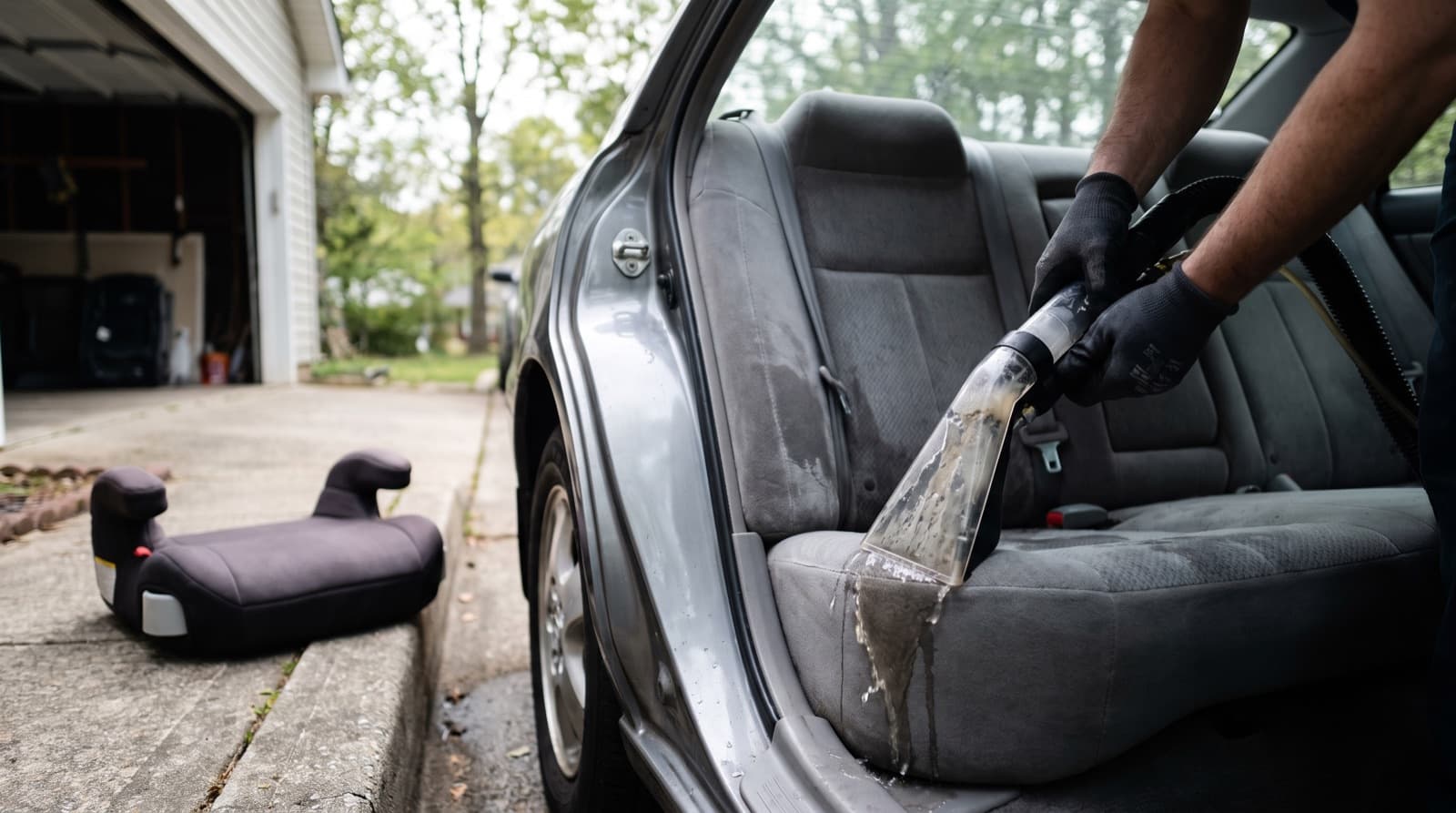
- Hot water extraction on carpets and cloth seats, with enough passes to pull the water back out
- Steam and a dedicated cleaner on hard surfaces, glass, and the headliner to cut nicotine film
- Check the spare tire well and under the carpet padding for standing water, then dry it fully
- Clear the sunroof and cowl drains, and replace the cabin air filter
Pro tip: Ozone should be the last ten percent of an odor job, not the plan. If a shop quotes you an ozone treatment with no extraction, you are paying for a temporary result.
Ozone vs enzyme cleaners vs thermal fogging
Ozone is one option among several, and the right pick depends on what kind of odor you have and where it lives. In practice the order is clean first, then enzyme the wet organic damage, then ozone whatever odor is left in the air and foam.
Here is how the common methods compare:
| Method | Best for | How it works | Main limitation |
|---|---|---|---|
| Ozone generator | Smoke, mildew, and residual odor throughout the cabin | Oxidizes odor molecules as a gas, reaching foam and HVAC ducts | Car must be unoccupied and aired out, and overuse degrades rubber and leather |
| Enzyme or bio cleaner | Urine, vomit, milk, and pet accidents in fabric and carpet | Enzymes digest the organic source inside the material | Needs moisture and dwell time, and only works where you can wet the surface |
| Thermal fogging | Heavy smoke and fire odor that soaked in deep | Heated deodorizer becomes a fog that follows the same path smoke took | Leaves its own scent and residue, and still requires full cleaning first |
| Chlorine dioxide packs | Mild musty odor and sensitive or older interiors | Slow-release gas oxidizes odor at much lower concentration | Far slower and weaker on heavy smoke, but much gentler on materials |
Do San Francisco cars need ozone more often?
Musty interiors are close to a local specialty here. Fog and the marine layer keep humidity high, and most of the cars we work on live outside on the street with no garage to dry out in. Carpet that gets wet in the Sunset or Outer Richmond can stay damp for a week.
The same patterns come up constantly:
One mobile detail note that matters for safety: we never run ozone in a closed underground garage where the gas can drift toward people. The car gets sealed and marked outdoors or in a well ventilated spot, then aired out completely with every door open before the keys go back. Playa dust after Burning Man is a different problem, and no amount of ozone substitutes for extraction there.
- Clogged sunroof and cowl drains from tree debris, which is the most common source of mystery mildew smell we find
- Street-parked cars collecting nightly condensation, road grime, and salt air through a cracked window
- Rideshare and family cars layering food, sweat, and spilled coffee over months without a deep clean
- Burning Man cars that come back with alkaline playa dust plus a week of biological odor in the fabric
Should you run ozone yourself or hire a pro?
DIY ozone is reasonable for a mild musty smell in a car you have already cleaned properly. Buy a machine with a real timer, keep cycles short, set it on a floor mat instead of a leather seat, and treat the airing-out step as mandatory. Never run it with anyone inside, and never where the gas can seep into living space.
Bring in a pro when the job needs more than a gas. Heavy smoke, visible mold, flood damage, urine that reached the padding, and lease returns with a deadline all need extraction, sometimes seat removal, and a sequence that puts cleaning before ozone. Doing it twice costs more than doing it right once.
We handle odor work as a mobile service, so the treatment happens in your driveway, at your office, or in your street spot anywhere in San Francisco, the Peninsula, or Marin. We bring our own water and power, do the extraction on site, run a controlled ozone cycle with the car sealed and empty, and air it out fully before you get back in. Interior detailing starts at $249 and a full detail is $399, with odor severity quoted after we see what is actually causing it.
Frequently Asked Questions
How long should you run an ozone machine in a car?
Twenty to thirty minutes handles a mild musty smell, and 30 to 60 minutes covers most moderate odors. Heavy smoke does better with two or three shorter sessions than one long one. Leaving a generator running overnight is where rubber seals, leather, and headliner adhesive start taking real damage.
How long does a car need to air out after ozone treatment?
Open all the doors for at least 30 to 60 minutes after the machine shuts off, and run the fan on fresh air to flush the ducts. Do not drive the car until the sharp, chlorine-like smell is completely gone. Ozone converts back into ordinary oxygen on its own, but a sealed cabin traps it much longer than an open one.
Will ozone damage leather seats?
A single controlled cycle will not, but repeated long exposure strips the oils and plasticizers that keep leather and vinyl flexible, which leads to dulling and eventually cracking. Keep cycles short and set the generator on a floor mat rather than on a seat. Conditioning the leather after treatment puts back some of what ozone takes.
Does ozone permanently remove cigarette smoke smell?
It can, but only after the tar film is physically removed from the glass, plastics, and headliner. Nicotine residue keeps releasing odor compounds for years, so ozone by itself buys a few good days before the smell returns. Steam and extraction, a fresh cabin filter, and then ozone is the combination that makes the result stick.
Can ozone kill mold in a car?
Ozone knocks down the musty odor and can suppress surface spores, but it does not remove mold growth, staining, or the moisture that caused it. If you can see mold, the carpet and padding need to come out, get cleaned and dried, and the leak has to be fixed. Treating a still-wet car with ozone just means the mold grows back.
Does Golden Bay Detailing use ozone treatments?
We use it as a finishing step on smoke, mildew, and biological odor jobs, never as the whole plan. Every odor job starts with source removal, steam, and hot water extraction, then a short controlled ozone cycle with the car sealed and empty, then a full airing out before the keys go back. If we look at your car and think cleaning alone will solve it, we will tell you that instead of selling you a machine cycle.
Keep reading from Golden Bay
Smell still there after cleaning? Let us find the source.
mobile odor removal across San Francisco, the Peninsula, and Marin. Tell us what happened in the car and we will send a free, honest quote, including whether you even need ozone.