Problem Solvers
How to Remove Scuff Marks From a Car: A Simple Guide
Key Takeaways
- To remove scuff marks from a car, first find out if the mark is paint transfer sitting on top of your clear coat or a real scratch cut into it; transfer wipes off, a scratch does not.
- Most scuffs from a pole, a shopping cart, or another car's bumper are the other object's paint or rubber smeared on your surface, so your paint underneath is usually fine.
- Do the fingernail test: if your nail glides over the mark and it smears or lightens when you rub it, it is transfer; if your nail catches in a groove, it is a scratch.
- Remove transfer with the gentlest method first: an all-purpose cleaner on a microfiber, then a damp Magic Eraser, then clay, and only a light compound if a faint scratch remains.
- Keep a Magic Eraser wet and use light pressure on glossy clear coat only, never on matte paint or a vinyl wrap, and reseal the spot with wax afterward.
To remove scuff marks from a car, first figure out whether the mark is paint transfer sitting on top of your clear coat or a real scratch cut into it. Transfer wipes off with an eraser, clay, or a light compound. A true scratch needs polish, touch-up paint, or a pro. The fix depends on which one you have, not on how bad it looks.
Here is the part most people miss. A lot of ugly marks from a pole, a shopping cart, or another car's bumper are not damage at all. They are the other object's paint or rubber smeared onto your surface. Your paint underneath is often perfectly fine, and the color rubs right off with the right approach.
At Golden Bay Detailing here in San Francisco, our technicians have cleaned up scuffs on 500-plus cars, most of them from tight garages and street parking. Here's how to tell transfer from a scratch in 30 seconds, then remove it the safe way.
Scuff or scratch? Do the fingernail test first
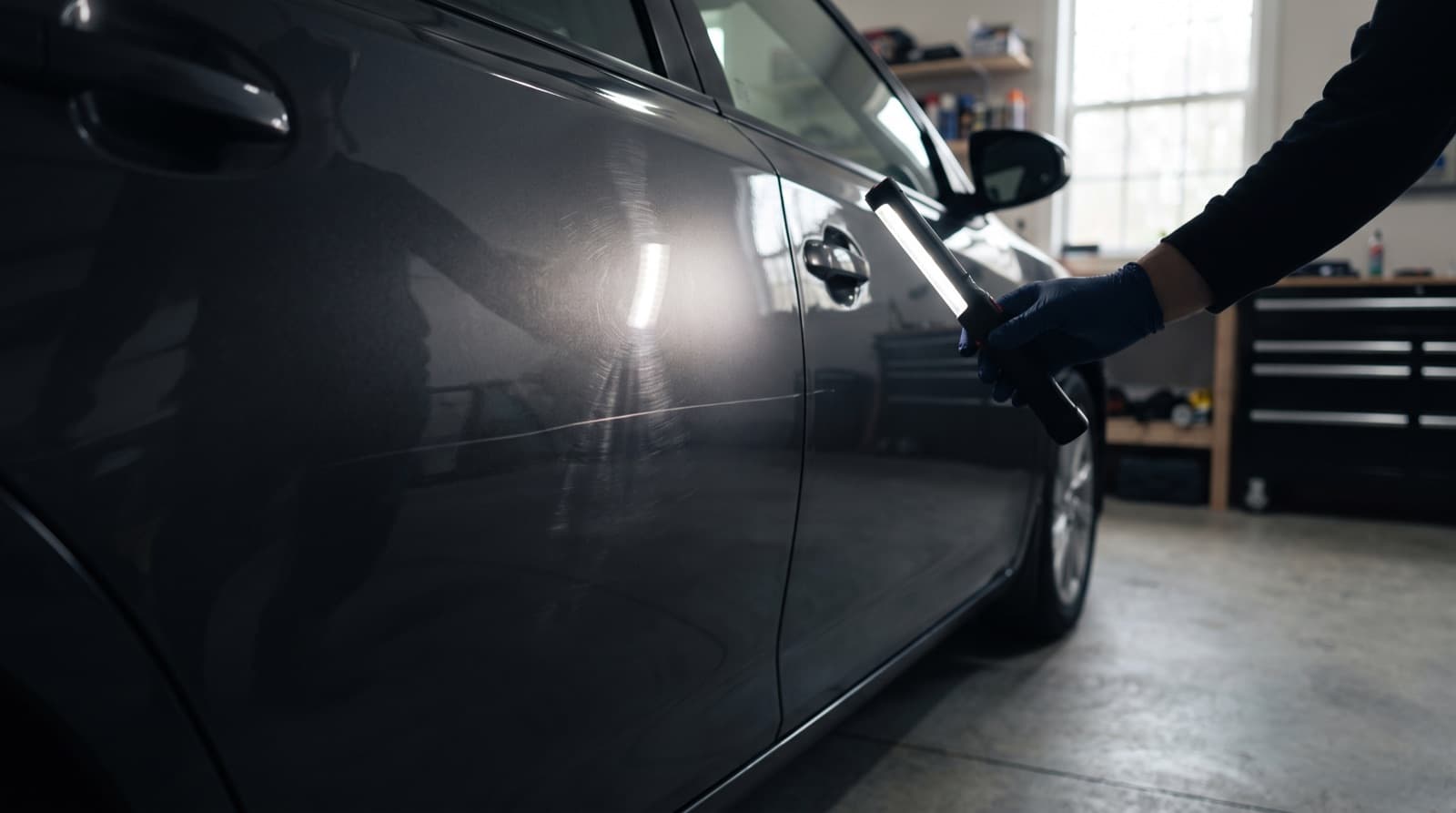
Wash and dry the spot, then look closely and drag a fingernail across it. Paint transfer usually sits level with or slightly proud of the surface and shows the other object's color: black rubber from a bumper, gray from a concrete pillar, or a streak of the other car's paint. A scratch is a groove cut down into your clear coat.
This 30-second test tells you the fix before you spend a dollar. It stops you from buying compound for a mark that wipes off, or scrubbing an eraser over real damage that needs paint.
- Nail glides over and the mark smears or lightens when you rub with a rag: paint transfer. It will very likely wipe, erase, or clay off.
- Nail lightly catches on a fine line: a clear-coat scratch. Reach for polish or compound, not an eraser.
- Nail drops into the groove, or you see white, gray, or bare metal: it is through the paint and needs touch-up or a body shop.
Pro tip: Test with a damp microfiber and a little all-purpose cleaner before you buy anything abrasive. Half the 'scratches' people show us wipe off in one pass because they were rubber or paint transfer the whole time.
The ways to remove paint transfer, cheapest first
Once you know it is transfer, start gentle and only step up if the mark stays. Here is what each method removes, what it costs, and how much work it is.
| Method | What it removes | Rough cost | Effort |
|---|---|---|---|
| Cleaner + microfiber (all-purpose, bug and tar, or diluted alcohol) | Fresh rubber, light scuffs, smears | $5 to $15 | 5 min, easy |
| Magic Eraser (melamine foam), kept wet | Stubborn scuffs on glossy clear coat | $3 to $6 | 5 to 10 min, careful |
| Clay bar or clay mitt + lube | Bonded transfer over a whole panel | $15 to $30 | 15 to 30 min, easy |
| Rubbing compound + polish | Transfer plus a light scratch under it | $20 to $40 | 20 to 40 min, moderate |
| Machine buff or pro correction | Deep marks, whole-panel scuffing | $120+ tool, or a pro | 1 to 3 hrs, skill |
How to remove a scuff mark, step by step
This is the driveway order of operations. Always start with the gentlest method and step up only if the mark holds on. Work in the shade on a cool panel so you can see the true result.
- 1. Wash and dry the area so you don't grind grit into the paint while you rub.
- 2. Spray an all-purpose cleaner or bug-and-tar remover on a clean microfiber and rub the scuff with light pressure. A lot of transfer lifts right here.
- 3. Still there? Wet a Magic Eraser, wring it out, and rub gently in short passes. Keep it damp, keep the pressure light, and check every few passes.
- 4. For a larger scuffed area, clay the panel with a quick-detailer lube to pull off any bonded transfer the rag missed.
- 5. If a faint scratch remains once the color is gone, work a scratch-remover polish or light compound into it, then wipe clean.
- 6. Seal the spot with a spray wax or sealant, because scrubbing strips whatever protection was there.
Pro tip: Never dry-rub a Magic Eraser. Dry melamine foam is far more aggressive and can haze your clear coat. Wet, light, and slow is the whole trick.
When a scuff won't come out (it's a scratch)
If your nail catches and the mark stays after the color is gone, you are no longer dealing with transfer. You have a scratch, and it follows scratch rules: polish for light clear-coat lines, touch-up paint if it reached the color, and a body shop if you see primer or metal.
Stop scrubbing at that point. More pressure with an eraser or compound only thins your clear coat and can burn through a panel edge, which is a much more expensive fix than the scratch you started with. That is where a machine and a trained hand earn their keep.
Where San Francisco drivers pick up scuffs
In the city, scuffs come from tight spaces far more than the open road. Concrete garage pillars, curb-hugging street parking, the low bollards outside shops, and other people's bumpers on a packed block all leave a mark, and it is usually transfer, not deep damage.
That is good news. A gray pillar streak or a black bumper rub on your door is almost always the pillar or the bumper on your paint, not a gouge in it. Ten minutes with cleaner and an eraser usually erases the whole panic.
- Garage pillars and low walls: gray or white concrete transfer, wipes off.
- Parking poles and bollards: paint or rubber streaks, erase or clay off.
- Shopping carts and door dings: often transfer plus a small scratch.
- Another car's bumper on a tight street: black or colored transfer, usually surface-only.
Pro tip: Because we come to you, our technicians fix a lot of these in a driveway or an office garage before the owner even leaves for the day. If a scuff won't budge with a rag, snap a photo and text it before you buy a kit.
Should you DIY it or call a pro?
Fresh paint transfer and light scuffs are a solid DIY job. A microfiber, a cleaner, and a Magic Eraser handle most of them for under $15, and you'll know within minutes whether it is working.
Call a pro when the mark spans a large area, when a scratch stays after the transfer is gone, or when your finish is matte paint or a vinyl wrap, since an eraser will dull those. Machine correction removes what hand work can't, safely, without over-thinning your clear coat.
Frequently Asked Questions
Does a Magic Eraser remove scuff marks from a car?
Yes, on glossy clear coat, as long as you keep the foam wet and use light pressure. Melamine foam is mildly abrasive, so it works on scuffs but should never be dry-rubbed, used on matte paint, or used on a vinyl wrap. Test a hidden spot first and follow with wax to reseal the area.
How do I remove paint transfer from another car off my bumper?
Wash the spot, then rub it with an all-purpose cleaner or bug-and-tar remover on a clean microfiber. Much of the transfer is the other car's paint sitting on top of your clear coat, so it lifts without any damage. If a faint scratch remains once the color is gone, step up to a light scratch-remover polish.
Will WD-40 or toothpaste remove car scuffs?
WD-40 can loosen rubber and tar scuffs, but you must wash it off completely afterward so it doesn't attract dirt or harm trim. Toothpaste is a very mild abrasive that sometimes helps on tiny marks but is inconsistent. A dedicated cleaner, clay, or compound is more reliable and safer for your paint.
How can I tell a scuff from a scratch?
Do the fingernail test. If the mark smears or lightens when you rub it and your nail glides over the surface, it is transfer, which is a scuff. If your nail catches in a groove, it is a scratch cut into the clear coat and needs polish or touch-up paint instead of an eraser.
Can Golden Bay Detailing remove scuff marks at my home?
Yes. We're a mobile detailer serving all of San Francisco, the Peninsula, and Marin, and we bring our own water and power to your driveway, office, or garage. We can wipe paint transfer during a detail or machine-correct a real scratch as a paint-correction service. Text a photo for a quick read, or grab a free quote at /get-a-quote.
Keep reading from Golden Bay
Scuff that won't budge? We'll take a look for free.
Golden Bay Detailing comes to your driveway or office anywhere in San Francisco with our own water and power. Text a photo or grab a free quote, and we'll tell you straight: wipe-off scuff or a job for the machine.