Problem Solvers
How to Remove Swirl Marks From Car Paint the Right Way
Key Takeaways
- To remove swirl marks from car paint, polish the clear coat: by hand with a cutting polish for light swirls, or with a dual-action machine polisher for a faster, more even correction.
- Swirl marks are fine spiderweb scratches in the clear coat, which is why they only appear as a halo under direct sunlight or a single bright light and disappear in shade.
- Most swirl marks are caused by washing and drying: automatic brush washes, dirty wash mitts, single-bucket washing, and wiping dust off dry paint.
- Machine paint correction removes a micro-thin layer of clear coat to level out the scratches and is the most reliable fix for heavy or dark-paint swirling.
- Polishing only lasts if you change how you wash, so use the two-bucket method, a clean microfiber mitt, and skip automatic brush car washes to keep swirls from coming back.
To remove swirl marks from car paint, you polish them out. Light swirls come out by hand with a cutting polish and a foam pad. Heavier swirling comes out faster and more evenly with a dual-action machine polisher. Swirl marks are ultra-fine scratches in your clear coat, so leveling that thin top layer erases them.
Here is the catch most people miss: you also have to fix how you wash the car, or the swirls come right back. Swirls are wash damage, not bad luck. Polish removes them today. Better habits keep them gone.
We are Golden Bay Detailing in San Francisco. Our technicians correct swirled paint almost every week, on black Teslas, garage-free daily drivers, and cars chewed up by tunnel washes. Here is the honest playbook: what causes swirls, what you can safely do yourself, and where a machine earns its keep.
Why swirl marks only show in direct light
Swirl marks are microscopic scratches in the clear coat, arranged in a fine, circular, spiderweb pattern. Each tiny scratch has edges, and those edges catch light.
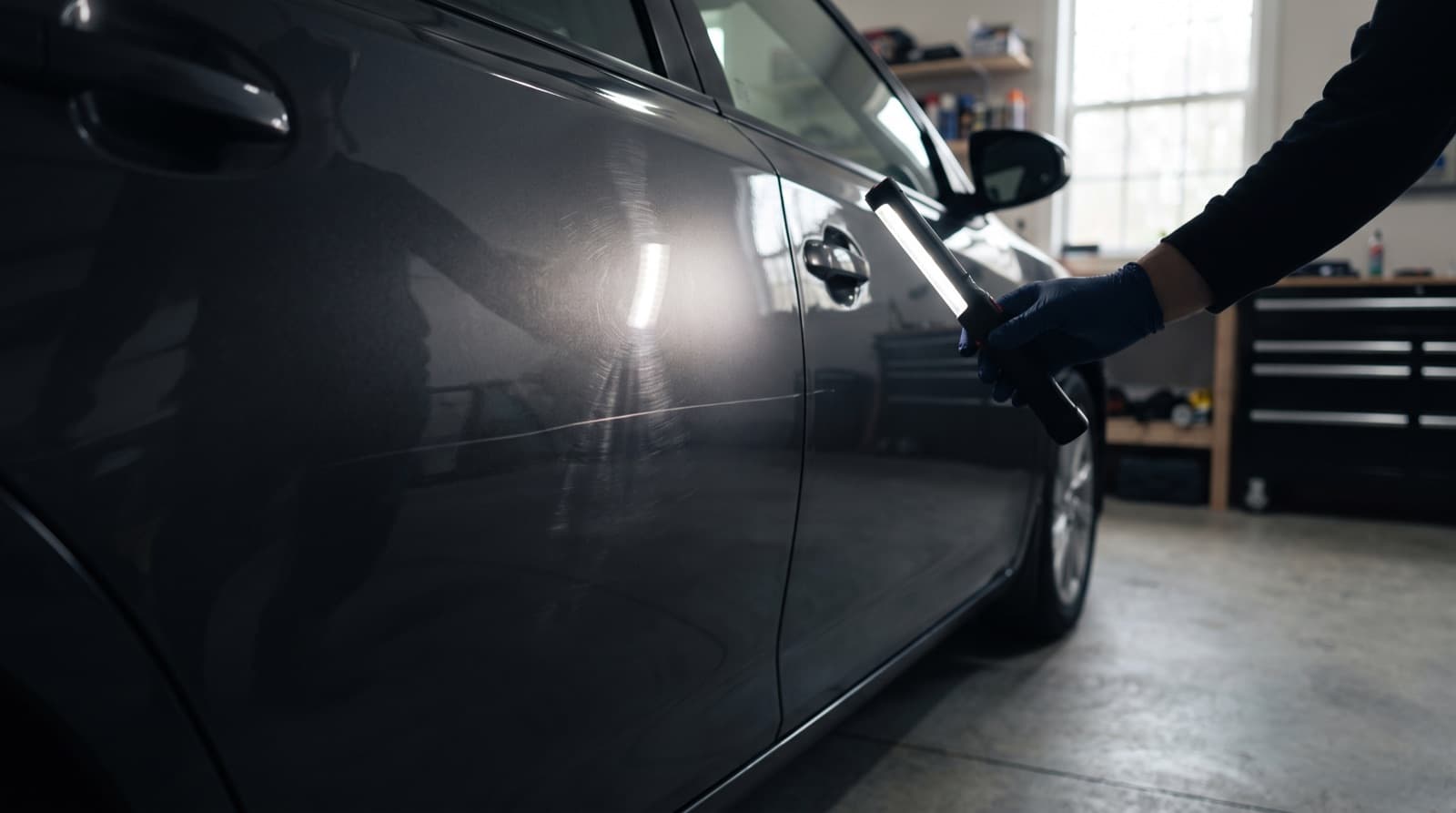
Under a single bright light source, like the sun or a showroom LED, every scratch edge bounces light straight back at your eye. Together they form a glowing halo of swirls around the light. In shade, fog, or cloud, the light is soft and scattered, so the same scratches have nothing to reflect and basically vanish.
That is why your car can look flawless on a gray San Francisco morning and look wrecked the moment the sun burns through at noon. The paint did not change. The lighting did.
Pro tip: To inspect for swirls at home, pull the car into a dark garage at night and shine a phone flashlight or a bright single LED across the paint at an angle. Diffuse daylight hides them; a point source exposes every one.
What actually causes swirl marks
Almost all swirl marks are self-inflicted during washing and drying. Grit gets dragged across the paint, and each speck cuts a tiny arc. Do that a few hundred times and you get the spiderweb.
Knowing the causes matters, because removing swirls without changing these habits just resets the clock.
- Automatic tunnel washes with spinning brushes, which drag reused grit across every car that day
- Washing with a dirty or dropped mitt that picks up grit off the ground
- Single-bucket washing, where you keep rinsing dirt back onto the same mitt
- Drying with a rough bath towel instead of a plush microfiber
- Wiping dust or bird droppings off dry paint instead of rinsing first
- Circular wiping motions, which turn straight scratches into visible swirls
Can you remove swirl marks by hand?
Yes, for light swirls. Hand polishing works on a small panel or a lightly hazed finish, and it needs no machine.
Wash and dry the car first, then feel the paint. If it is rough, use a clay bar or clay mitt to pull out bonded grit so you do not grind it in while polishing. Then work a cutting polish like Meguiar's Ultimate Compound, Scratch X, or a 3D one-step onto a foam applicator, spread it over a small two-foot section, and rub with firm, straight, overlapping passes. Wipe the residue with a clean microfiber and check the panel in good light.
Be honest with yourself about the limits. Hand polishing is slow, it is a forearm workout, and on black or dark paint it usually gives only partial correction. If the whole car is swirled, hand work will wear you out before it looks even.
The real fix: machine paint correction
Machine paint correction is the reliable way to remove swirl marks, especially on dark paint or a heavily marred car. A polisher spins a foam pad with polish across the surface, cutting a micro-thin layer off the clear coat so the scratches are leveled flat instead of just filled.
For DIY, use a dual-action (random-orbital) polisher. It wobbles as it spins, which makes it very hard to burn the paint, so it is beginner-safe. A rotary buffer cuts faster but builds heat and can burn through clear coat in seconds, so leave that to pros.
Correction comes in stages. A one-step (a compounding polish on one pad) removes most swirls and light scratches. A two-step or multi-stage process, cutting then refining, is for heavy swirling or a flawless show finish. A pro also measures your clear coat with a paint gauge first, because that top layer is only so thick and you can only correct it so many times.
| Method | Best for | Effort | Risk | Result |
|---|---|---|---|---|
| Hand polish | Light swirls, small areas | High, slow | Low | Partial, uneven on dark paint |
| DA machine + polish | Most swirls, light scratches | Moderate | Low to medium | Strong, even correction |
| Rotary or multi-stage (pro) | Heavy swirls, dark paint, show finish | High | High (heat, burn-through) | Flawless, mirror finish |
How to keep swirl marks from coming back
This is the part that actually saves you money. Corrected paint stays corrected only if you stop re-scratching it. Change the wash, keep the shine.
San Francisco makes this trickier than most places. The marine layer keeps cars damp and coated in fine grit, most people park on the street with no garage, and after a Burning Man run the playa dust is genuinely abrasive. Rinse that stuff off, never wipe it dry.
- Use the two-bucket method: one bucket of soapy water, one of clean rinse water, each with a grit guard at the bottom
- Wash with a soft microfiber wash mitt, and rinse it in the clean bucket often
- Skip automatic brush tunnels; a touchless wash is safer, a careful hand wash is safest
- Dry with a plush microfiber drying towel or a filtered blower, not a bath towel
- Never wipe dust, sap, or droppings off dry paint; rinse or spray-detail first
- Wipe in straight lines, not circles, and keep a separate mitt for the dirty wheels
Pro tip: After a dusty week or a trip out to the playa, hit the car with a hose or rinseless spray before you touch it with any towel. Dry playa dust is like sandpaper, and wiping it is how a clean car gets swirled in one pass.
Does ceramic coating stop swirl marks?
A ceramic coating adds a hard, slick sacrificial layer on top of your clear coat. It resists light marring, and it makes washing safer because dirt releases more easily and slides off with less rubbing. That real-world protection is why a lot of our clients coat after a correction.
But ceramic is not scratch-proof. A dirty mitt or a brush tunnel can still swirl a coated car. The smart order is to correct the swirls first, then coat, so you seal a flawless finish under the protection instead of locking swirls in.
If your paint is already swirled and you want it fixed and protected in one visit, that is exactly what a correction-plus-coating package is built for.
Frequently Asked Questions
Why do swirl marks only show in the sun?
Swirl marks are microscopic scratches in the clear coat, and under a single bright light source each edge reflects light back at you in a circular halo. In shade, fog, or cloud the light is diffused, so the scratches have nothing to reflect and seem to disappear. That is why the same car can look perfect on a gray morning and heavily swirled at noon.
Can you remove swirl marks by hand?
Yes, light swirls come out by hand with a cutting polish and a foam applicator, using firm straight passes on a small section at a time. It is slow, though, and on dark paint it usually gives only partial correction. For a car that is swirled all over, a dual-action machine does a cleaner, more even job in far less time.
Will swirl marks come back after polishing?
Only if you keep washing the car the way that caused them. Polishing removes the scratches for good by leveling the clear coat, but automatic brush washes, dirty mitts, and dry wiping will re-scratch fresh paint within weeks. Switch to a careful two-bucket wash and the finish stays clean.
Does an automatic car wash cause swirl marks?
Yes, it is one of the top causes. The spinning brushes and reused, gritty water in many tunnel washes drag debris across your paint on every pass. Touchless washes are much safer, and a careful two-bucket hand wash is the safest option of all.
Does ceramic coating prevent swirl marks?
Ceramic coating adds a hard, slick layer that resists light marring and makes washing safer, but it is not scratch-proof. The best approach is to correct the swirls first and then coat, so you seal a flawless finish instead of trapping the swirls underneath. It reduces how easily new swirls form, but good wash habits still matter.
How much does it cost to remove swirl marks?
At Golden Bay Detailing, a one-step paint correction that removes most swirls starts at $399, with two-step ($799) and multi-stage ($1,199) options for heavier or dark-paint swirling. We are fully mobile, so we come to your driveway or office anywhere in San Francisco and bring our own water and power.
Keep reading from Golden Bay
Swirls gone. Shine back. We come to you.
Golden Bay Detailing corrects swirled paint right in your San Francisco driveway or office, with one-step correction from $399. Text or call (415) 483-5686 for a free quote.