How-To
How to Clean Car Air Vents and Kill the Musty Smell

Key Takeaways
- Clean car air vents by dry-brushing each vane with a soft detail brush or a foam craft brush while the fan runs on low, then blowing the loosened dust out with compressed air and wiping the vent face with a damp microfiber towel.
- A musty or dirty-sock smell from the AC is almost always mold and bacteria growing on the damp evaporator core behind the dashboard, not dirt on the vent slats.
- Replacing the cabin air filter, usually behind the glovebox and about $15 to $40, restores airflow and removes the largest trapped source of dust and mildew odor.
- Foaming automotive evaporator cleaner applied through the filter housing or up the condensate drain tube kills the growth at the source; run the blower on high with the AC off afterward to dry the system.
- Golden Bay Detailing's $249 mobile interior detail covers vents, ducts, and trim across San Francisco, the Peninsula, and Marin, with dedicated odor removal quoted after an in-person inspection.
Here is how to clean car air vents fast: brush the dust out of the slats with a soft detail brush or a foam craft brush, run the blower on low, blow the loosened dust out with compressed air, then wipe the vent face with a lightly damp microfiber towel. Ten minutes, no parts coming off the dash.
The musty smell is a different job. That odor lives on the AC evaporator core deep behind the dashboard, and no amount of brushing the vent vanes will touch it. Fixing it takes a fresh cabin air filter, a foaming evaporator cleaner, and one small change in how you shut the car off.
We detail cars in San Francisco, where fog, the marine layer, and short cold crosstown drives keep that evaporator wet almost year-round. Below is the order our technicians work in, what they actually use, and where DIY stops being enough.
What is the fastest way to clean dusty air vents?
Start with the ignition on and the blower running on low, set to fresh air rather than recirculate. Moving air pushes the dust you loosen out of the duct instead of letting it drop deeper into the housing. That one step is the difference between cleaning vents and relocating dirt.
Work dry first. Dust plus cleaner equals mud, and mud packed into a vent slat is much harder to remove than dry lint.
- Set the fan to speed one or two with the AC off and the vents aimed out at you.
- Dry-brush every vane with a soft boar's hair detail brush or a quarter-inch foam craft brush, top vane down.
- Follow with short bursts of compressed air or an electric blower held at a slight angle, so debris exits the slats instead of packing into a corner.
- Turn the fan off, then wipe the vent face and surrounding trim with a lightly damp microfiber towel.
- Vacuum the carpet and the front faces of the seats last, because everything you blew out landed there.
Pro tip: Foam craft brushes from a craft store cost about a dollar and are the best vent tool we own. The foam flexes into the slat, holds a little cleaner without dripping, and our technicians throw it away instead of trying to rinse dust out of bristles.
Which tools work on vents, and which ones cause damage?
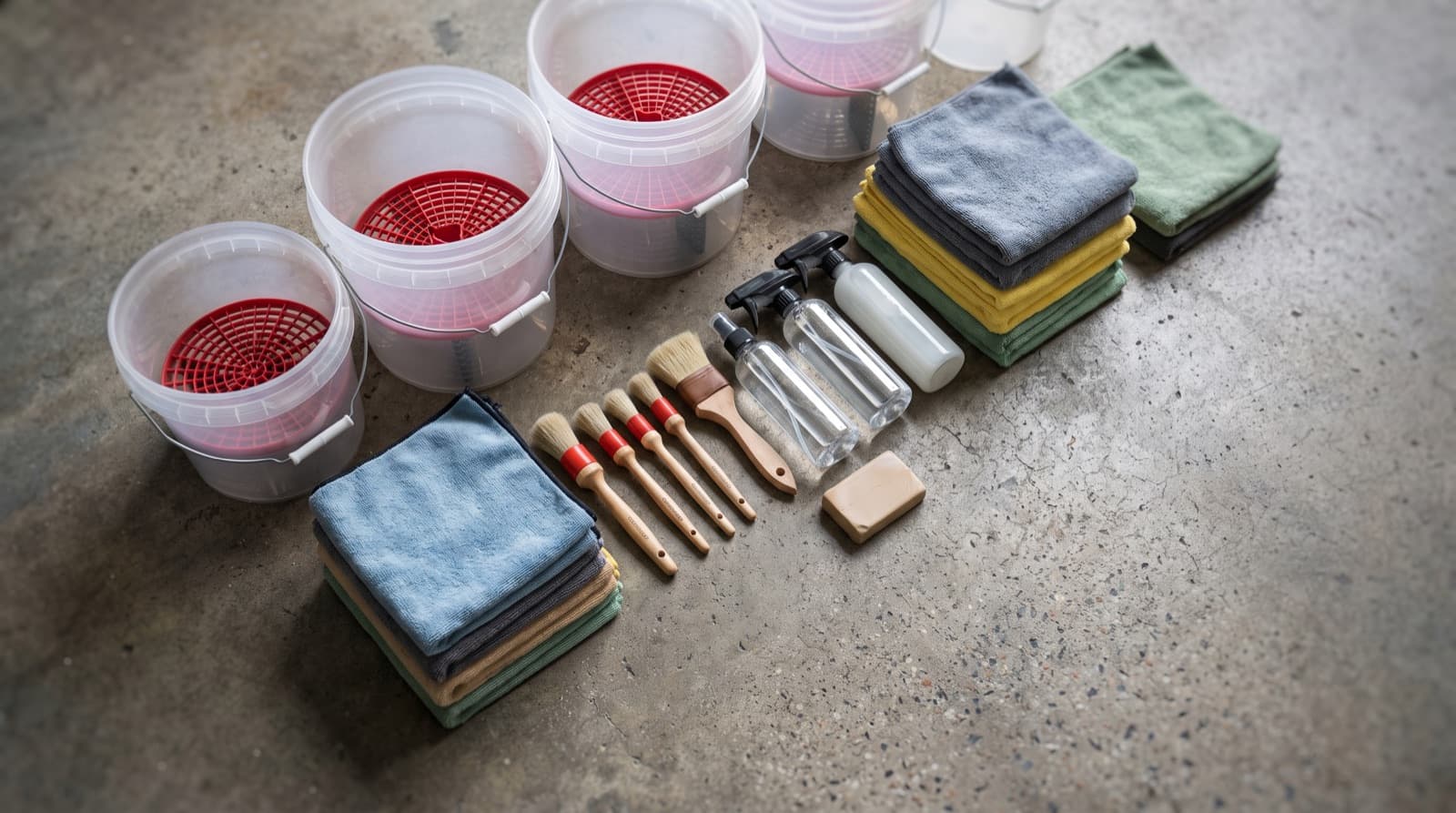
You do not need a kit. You need something soft enough to enter a slat without marking it, and something that moves air. Everything else is convenience.
| Tool | Best for | Watch out for |
|---|---|---|
| Soft boar's hair detail brush | Loosening dust on vanes, seams, and trim edges | Stiff nylon brushes scuff soft-touch and gloss piano-black plastic |
| Foam craft brush, 1/4 to 1/2 inch | Narrow slats and full-width vents like Tesla's | Foam tears if you force it; use light pressure |
| Compressed air or electric blower | Pushing dust out of the duct, not just the visible face | Canned air can spit cold liquid propellant and stain trim |
| Lightly damp microfiber towel | Final wipe on the vent face and bezel | A soaked towel drips water straight into the duct |
| Interior cleaner such as P&S Xpress, 303, or Koch-Chemie Top Star | Greasy film and fingerprints on gloss vent surrounds | Spray the towel or brush, never into the vent opening |
| Shop vac with a soft brush attachment | Catching debris as the blower kicks it loose | Hard plastic attachment edges scratch dash plastic |
Why does my car AC smell musty or like dirty socks?
The smell is not coming from the vent slats. Your AC evaporator core sits behind the dash, gets cold, and pulls water out of the air the same way a cold glass sweats. That water sits on aluminum fins in the dark, coated in fine dust that slipped past the cabin air filter, and mold and bacteria grow in it.
That is why the odor is strongest in the first ten to thirty seconds after you switch on the AC, then fades as airflow dries the surface. Shops call it dirty sock syndrome, and it is one of the most common complaints we hear before an interior detail.
Not every bad smell is the evaporator, though. Match the symptom to the cause before you buy anything, because two of these are not detailing problems at all.
| Symptom | Likely cause | What fixes it |
|---|---|---|
| Musty burst for 10 to 30 seconds when the AC starts, then fades | Mold on the evaporator core | Foaming evaporator cleaner plus a new cabin filter |
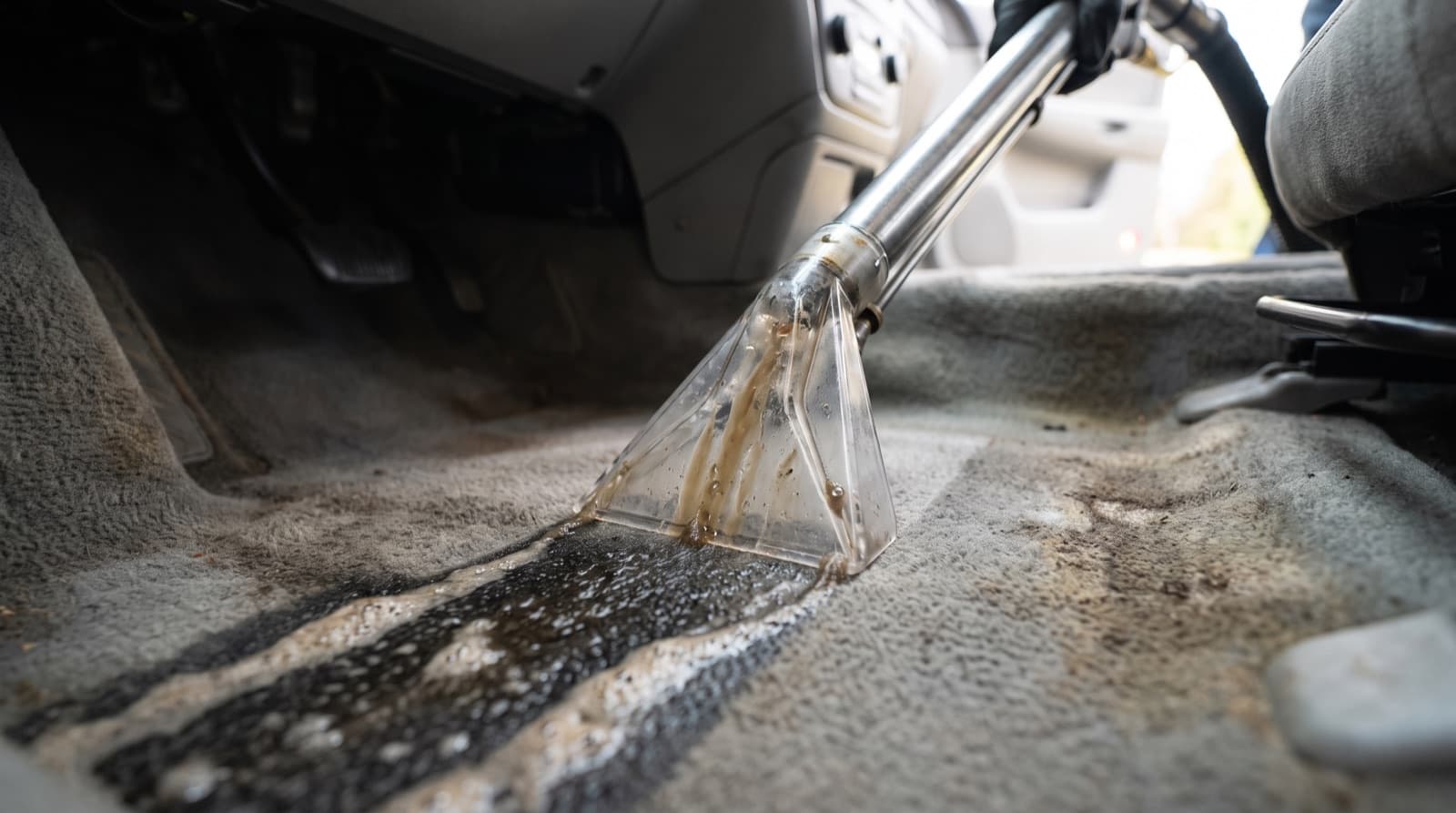
| Constant stale smell even with the fan off | Spills, damp carpet, pet dander, or wet mats | Hot water extraction of carpet and upholstery |
| Water pooling in the passenger footwell | Clogged AC condensate drain tube | Clear the drain grommet from under the car |
| Weak airflow with a dusty smell | Cabin air filter packed with debris | Replace the filter |
| Smell only on heat, not on AC | Leaves and debris in the cowl intake or blower box | Clear the cowl grille at the base of the windshield |
| Sweet syrup smell with a greasy film on the windshield | Leaking heater core | See a mechanic, not a detailer |
How do you replace a cabin air filter?
The cabin air filter is the cheapest fix in the car, and on most vehicles it hides behind the glovebox. Empty the glovebox, release the side stops or the damper arm, drop the box down, and you will see a plastic door roughly the size of a paperback.
Slide the old filter out and note which way the airflow arrow points, usually down toward the blower. Filters install in one direction only. If yours comes out gray, matted, and holding a small collection of pine needles, that alone was costing you airflow and adding a stale note to every drive.
Budget about $15 to $40 for the filter and ten minutes of work. Activated charcoal filters like the Fram Fresh Breeze, or a HEPA-style Bosch, help with street and exhaust odors. Understand what they do, though: they filter incoming air. They cannot clean growth that already exists downstream on the evaporator.
EV owners are not exempt. Teslas use stacked filters with a longer factory interval, and Model 3 and Model Y owners here often find them loaded early, because city driving is slow-speed crawling through brake dust and pollen. Check your manual for the interval, then judge by the condition of the filter you pull out.
Pro tip: Write the date and mileage on the edge of the new filter frame with a marker. Next year you will not have to guess, and neither will the next owner.
How do you kill the mold on the evaporator core?
This is the step that actually removes the smell. You want a foaming HVAC cleaner made for automotive evaporators. Lubegard Kool-It Evaporator and Heater Foam Cleaner, Nu-Calgon Evap Foam No Rinse, and Wurth Klima-Cleaner all do the job. Air fresheners, fabric sprays, and disinfectant wipes do not.
Skip the aerosol foggers that tell you to run recirculate and empty a can into the footwell. Those coat the cabin in fragrance and leave the biofilm untouched. The real process takes about half an hour, and most of that is waiting.
- Park where liquid can drip under the car, and open both front doors for ventilation.
- Remove the cabin air filter so you can reach the blower housing and the evaporator behind it.
- Feed the cleaner's hose either through the filter opening onto the evaporator face, or up the condensate drain tube, the small rubber nipple poking through the firewall on the passenger side.
- Empty the can slowly so the foam expands across the fins, then leave it alone for fifteen to twenty minutes while it liquefies and drains out.
- Install the new filter, start the car, set the blower to high on fresh air with the AC off, and run it ten minutes with the windows down to dry the system.
- Repeat once a week later if a faint smell lingers. Heavy growth sometimes needs two rounds.
Pro tip: If your passenger carpet is ever damp, the condensate drain is clogged and the whole system is sitting in water. Clear it with a plastic zip tie or a low-pressure air blast from underneath, never a stiff wire, and never before you know exactly where the evaporator sits above it.
Why do San Francisco cars go musty faster?
Humidity is the fuel, and this city hands it out free. Fog and the marine layer keep overnight humidity high from the Sunset to the Marina, and a car parked on the street never gets the dry, hot afternoon that bakes moisture out of an inland driveway.
Trip length makes it worse. A ten-minute crawl from Noe Valley to SoMa runs the AC, soaks the evaporator, then shuts down while it is still wet. Do that twice a day for a month and you have built a small greenhouse behind your dashboard.
Then add the things specific to living here. Most people have no garage. Wet shoes and damp gym bags go into a sealed car. Recirculate stays on to keep street and exhaust smells out, which also traps the moisture you breathe out. Cowl drains under the windshield fill with leaves on blocks lined with ficus and eucalyptus. Salt air off Ocean Beach and the Great Highway settles on everything, including the intake.
- Switch the AC off two or three blocks before you park and let the blower run on fresh air. This dries the evaporator before shutdown and is the single most effective habit on this page.
- Use fresh air instead of recirculate whenever the traffic around you allows it.
- Run rubber floor mats through the wet months and pull them out to dry after storms.
- Clear leaves out of the cowl grille at the base of the windshield a couple of times a year.
- Crack the windows on the rare warm day instead of sealing a damp interior shut all week.
Pro tip: On the fleet and rideshare cars we service in the city, the ones that never smell belong to drivers who do the fan-only dry-down. It costs nothing, and it explains why some high-mileage cars smell clean and others never do.
How often should you clean vents and change the filter?
Frequency depends on where the car sleeps and what it drives through. This is the schedule we give clients in San Francisco and down the Peninsula.
- Vent dusting: every wash or every other wash, five minutes with a brush and a blower.
- Cabin air filter: once a year for a typical commuter, or every six months for rideshare and delivery drivers, dog owners, and anyone parked under trees.
- Evaporator foam cleaner: once a year, or immediately the first time that musty burst comes back.
- Fan-only dry-down: every single time you use the AC.
- Full interior with carpet and seat extraction: once or twice a year, since damp carpet produces a smell nearly identical to evaporator mold.
When should you stop and call a detailer?
Vent dust, a cabin filter, and one round of evaporator foam are genuinely DIY. Most people can do all three in an afternoon for under $60 in materials, and we would rather you do that than pay anyone.
Call for help when the smell returns within a few weeks, when there is visible fuzz on the vent vanes or the blower wheel, when the carpet has been wet, or when smoke, spilled milk, pets, or a rideshare career are in the car's history. Those need extraction, surface treatment, and sometimes access behind the blower housing. Chasing them with cans is how people spend $200 on products and still drive a car that smells.
Golden Bay Detailing is mobile, so our technicians bring their own water and power to your driveway, office garage, or the curb outside your building anywhere in San Francisco, down the Peninsula through San Mateo and Foster City, and up through Marin to San Rafael. A mobile interior detail is $249 and covers vents, ducts, trim, carpet, and upholstery. A full detail is $399. When the odor traces deeper than the interior, our technicians look at it in person before we quote odor removal, because guessing at a smell over the phone is how customers end up disappointed.
For context on who is telling you this: we are Golden Bay Detailing, System X certified, and we have detailed more than 500 cars in this city since 2022, with 97 five-star reviews and a 5.0 rating.
Frequently Asked Questions
Can I spray Lysol or Febreze into my car vents?
You can, but it will not fix a musty AC. Household disinfectants and fabric sprays add fragrance and moisture to a system that already has too much of both, and the smell usually returns within days. Use a foaming cleaner labeled for automotive HVAC evaporators instead, since it is designed to cling to the fins and then rinse itself out through the drain tube.
Does an ozone treatment get rid of musty AC smell?
Ozone knocks down odors living in the cabin and helps a lot with smoke and general staleness. It does not solve a dirty evaporator, because the moment that core gets wet again the growth restarts. Ozone also has to run in an empty car and be aired out completely before anyone gets in, so treat it as a finishing tool rather than the whole job.
Will cleaning the vents make my AC blow colder?
It often improves airflow noticeably. A packed cabin filter or a dust-caked evaporator restricts how much air moves through the system, so clearing both can feel like more cold air at the vents. If the air still is not cold after that, the issue is refrigerant, the compressor, or a blend door, and that belongs to a mechanic rather than a detailer.
Why does my car only smell musty for the first minute?
That is the signature of mold on the evaporator core. Sitting overnight, the damp fins concentrate the odor, then the first rush of air pushes it into the cabin and dries the surface enough for the smell to fade. It returns every time the system sits wet, which is why drying the evaporator before shutdown matters more than any spray you can buy.
Do EVs and Teslas get musty vents too?
Yes. Electric cars still cool cabin air by condensing moisture on a cold surface, so they create the same damp environment behind the dash. HEPA-style filters in Teslas capture more particulate, which also means they load up faster in city dust and pollen. Longer factory replacement intervals do not always match how a car actually gets used in San Francisco, so judge by the condition of the filter you remove.
Does Golden Bay Detailing clean air vents as part of a detail?
Yes. Vents, ducts, and the surrounding trim are part of every interior detail, which is $249 mobile at your home or office anywhere in San Francisco, the Peninsula, or Marin. If the smell traces back to the evaporator or to carpet that has been wet, our technicians inspect the car first and then we quote odor removal, so you pay to fix the actual cause instead of a guess.
Keep reading from Golden Bay
Still musty after the filter and the foam?
Get a free quote and our technicians will come to your driveway, office, or curb anywhere in SF, the Peninsula, or Marin, find where the smell is actually coming from, and tell you straight what it takes to fix it.